
April 25, 2006- Seoul, Korea
Anwar Hossain, President of the Migrants' Trade Union, was released from immigration detention today at about 5:45 pm after spending the last 11 months in Cheonju Detention Center. The Korean government cited his deteriorating health and two pending court cases as reasons for his release. Anwar was released on an open bond- the MTU paid the Korean government about $500 US Dollars for Anwar's release in exchange for an open-ended visa so that Anwar can receive medical treatment and recove rfrom his time spent in detention. There is no time limit on his stay in Korea.Anwar was greeted by more than 200 supporters and migrant workers upon his release. In a statement he gave to the Korean press, he said that he will keep fighting until every last migrant is free from detention and can have the freedom that he has today.
Tomorrow Anwar will be admitted to the hospital to receive much needed medical treatment for injuries sustained during his arrest, as well as health issues that he suffered while in jail.Anwar's release was unexpected and the news came after a week in which 4 migrant workers in Korea died trying to escape immigration crackdowns and another died while on the job. Pressure, within Korea and from abroad, hasbeen intensifying against the Korean government to release Anwar and stopthe violent crackdown on migrant workers.
The MTU would like to thankeveryone who has sent letters on Anwar's behalf, attended protests andrallies and helped in innumerable other ways. Anwar's release would nothave been possible without their help.The MTU is calling on all workers in Korea and around the world to uniteso that all may be free from oppression and discrimination. We at the Migrants' Trade Union firmly believe that an injustice to one is aninjustice to all and we will continue to fight together to free everyonefrom oppression.
Tuesday, April 25, 2006


Saturday, April 08, 2006
Pyeongtaek Unrest Continues
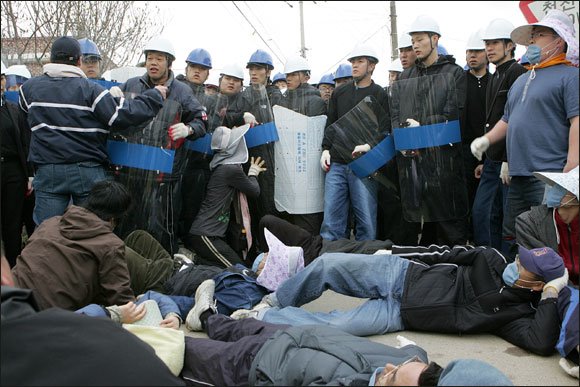
Looks like things went to hell yesterday in Pyeongtaek; meaning, it looks like the police, army, or whoever have finally evicted everyone. Who are these guys with the riot shields? they don't look familiar to me, are they construction workers, hired thugs --as in gangs-- or some special deputies or police I haven't heard about?
You can read more about this issue and the previous protests on our blog here and here. The Korea Herald ran a story on the topic today as well, Farmers injured in base protest. There were more than farmers involved from what I can gander from this post in Korean of pictures and a report from the protest. I looks like unionists and other protestors were involved. The pictures of the roadblock and the man under the truck are disturbing and difficult to figure out (was he blocking it or was he run over?). I'm looking forward to finding more stories in English on exactly what went down. Seems there are lots of injuries.
Monday, March 27, 2006
Spring Labour Struggle
An update from Koilaf on some upcoming labour issues.
Labor unions have threatened to launch an all-out struggle against the government and management next month over thorny labor issues, including an irregular workers bill and wage hikes.
The Korean Confederation of Trade Unions (KCTU) intends to call a general strike next week attempting to block the passage of the controversial bill during a plenary session at the National Assembly.
The country’s largest umbrella labor group, representing more than 800,000 workers, staged large-scale rallies earlier this month after the bill was approved by the Assembly’s environment and labor committee.
Relations between government, management and labor are expected to worsen further as rail and subway workers have also vowed to strike again unless management accepts their demands for better working conditions and greater labor rights.
Public transport workers staged a four-day walkout earlier this month, disrupting the nation’s transportation services, and causing public inconvenience. They returned to work, yielding to negative public sentiment and a tough police crackdown.
The unions are also drifting toward a head-on clash with management, over demands for wage rises and negotiations on reinstatement of dismissed union representatives.
read more...
The KCTU is expected to begin a 10-day strike on April 3, to urge the Assembly not to pass the non-regular workers bill, which it claims would increase the number of temporary workers.
They have also called on the government to revise its labor policy to be more worker-friendly and stop its Free Trade Agreement (FTA) negotiations with the United States. They argue an FTA with the U.S. would further aggravate the plight of farmers and irregular workers.
The Korea Rail Workers Union has also decided to, again, take collective action, saying the state-run Korea Railroad (Korail) has been indifferent to their demands, including reinstating fired workers and converting attendants of the Korea Train Express into regular workers.
The strike by unionized Korail workers is feared to disrupt passenger and freight services across the country for another time, forcing people to find alternative transport and causing financial loss to rail-reliant companies.
Also, shuttle bus workers in Seoul and Kyonggi Province plan to strike next month as they have failed to reach an agreement with management over wage increase.
Business organizations and labor unions are on collision course as they differ widely over various contentious labor issues.
The Korea Employers Federation (KEF) has asked its member companies not to pay labor union leaders from next year.
Employers have so far paid union leaders’ salaries but, under a new law, they will be ineligible for wages from their companies from 2007.
The KEF has also said it would not allow the unions a say in management, and it is solely up to management whether to hire, and how many non-regular workers they want to hire.
But the KCTU and another umbrella labor group, the Federation of Korean Trade Unions (FKTU), said they would stage an all-out struggle against employers, saying management’s stance on labor is unacceptable.
Management and labor also widely differ over wage hikes this year.
The KEF suggested employers raise wages by about 2.6 percent, a sharp contrast to the 9.6 percent hike demanded by the FKTU.
The employers’ organization even asked companies, suffering from the appreciation of the Korean won against the U.S. dollar, and high oil prices, to freeze wages this year.
Labor unions have threatened to launch an all-out struggle against the government and management next month over thorny labor issues, including an irregular workers bill and wage hikes.
The Korean Confederation of Trade Unions (KCTU) intends to call a general strike next week attempting to block the passage of the controversial bill during a plenary session at the National Assembly.
The country’s largest umbrella labor group, representing more than 800,000 workers, staged large-scale rallies earlier this month after the bill was approved by the Assembly’s environment and labor committee.
Relations between government, management and labor are expected to worsen further as rail and subway workers have also vowed to strike again unless management accepts their demands for better working conditions and greater labor rights.
Public transport workers staged a four-day walkout earlier this month, disrupting the nation’s transportation services, and causing public inconvenience. They returned to work, yielding to negative public sentiment and a tough police crackdown.
The unions are also drifting toward a head-on clash with management, over demands for wage rises and negotiations on reinstatement of dismissed union representatives.
read more...
The KCTU is expected to begin a 10-day strike on April 3, to urge the Assembly not to pass the non-regular workers bill, which it claims would increase the number of temporary workers.
They have also called on the government to revise its labor policy to be more worker-friendly and stop its Free Trade Agreement (FTA) negotiations with the United States. They argue an FTA with the U.S. would further aggravate the plight of farmers and irregular workers.
The Korea Rail Workers Union has also decided to, again, take collective action, saying the state-run Korea Railroad (Korail) has been indifferent to their demands, including reinstating fired workers and converting attendants of the Korea Train Express into regular workers.
The strike by unionized Korail workers is feared to disrupt passenger and freight services across the country for another time, forcing people to find alternative transport and causing financial loss to rail-reliant companies.
Also, shuttle bus workers in Seoul and Kyonggi Province plan to strike next month as they have failed to reach an agreement with management over wage increase.
Business organizations and labor unions are on collision course as they differ widely over various contentious labor issues.
The Korea Employers Federation (KEF) has asked its member companies not to pay labor union leaders from next year.
Employers have so far paid union leaders’ salaries but, under a new law, they will be ineligible for wages from their companies from 2007.
The KEF has also said it would not allow the unions a say in management, and it is solely up to management whether to hire, and how many non-regular workers they want to hire.
But the KCTU and another umbrella labor group, the Federation of Korean Trade Unions (FKTU), said they would stage an all-out struggle against employers, saying management’s stance on labor is unacceptable.
Management and labor also widely differ over wage hikes this year.
The KEF suggested employers raise wages by about 2.6 percent, a sharp contrast to the 9.6 percent hike demanded by the FKTU.
The employers’ organization even asked companies, suffering from the appreciation of the Korean won against the U.S. dollar, and high oil prices, to freeze wages this year.
Thursday, March 16, 2006
Restless Pyeongtaek
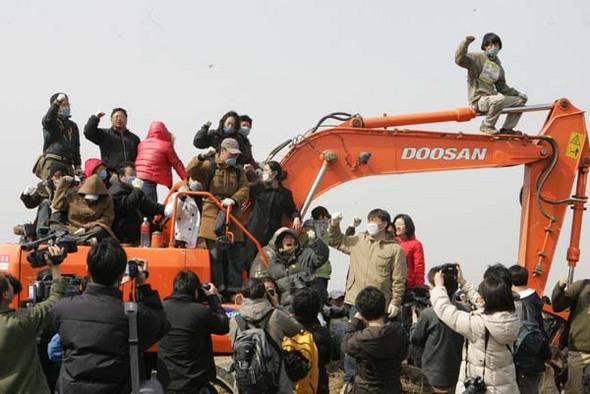
[Update (Mar 21'06) -- Here's the link to an Amnesty International report on the incident below.]
You may remember that a while ago we covered some of the protests against the expansion of the US army base in Pyeongtaek. We haven't posted much on this issue since then as we've been more focused with labour issues and haven't covered some of the other issues at hand. It seems that meanwhile as local culture of resistance has continued in Pyeongtaek, with activists and locals defending the villages of Daechuri and Doduri, and several ensuing confrontations with police and military as these forces attempt to seal off the contested land. As you may remember from our original post above and the many background links connected to it, the Yongsan base in Seoul is being relocated to Pyeongtaek and this partly what the uproar is about. There are many perspectives on the issues and I would encourage readers to do some background reading on them, but below I shall reprint a rather urgent message and two updates sent by the Daechuri English Media Collective describing the current state of confrontation.
The Daechuri collective connect the expansion to the Project For a New American Century (PNAC) and see as a larger part of the consolidation of American Military Hegemony in Northeast Asia in general and Korea in particular. This is a controversial interpretation which perhaps renders extreme geopolitical significance to a local issue that is indeed a little more complicated. Moving the Yongsan garrision out of Seoul seems to me to signal that the South Korean government increasing independance in foreign policy issues, at least regarding the North, however, this relative independence in policy issues regarding the north has entail some participation in US adventures in Iraq and thus speaks to more complicated and complicit geopolitics than simple American domination. These words of caution aside, the fight brewing in Pyeongtaek is sure to reverberate for some time, and speaks to some real issues of regional disparity, forced displacement, and issues of police violence -- all of which are complicated by both national and geopolitical dynamics but, in my opinion, not solely reducible to one or the other. Thus, it seems important to publicize these events, especially as the protestors own description of the events rarely make it into the international press. Below are the original messages from the Daechuri collective including today's update.
Autonomous Village Under Siege by Korean Troops Rhizome Collective // Daechuri English Media Collective
08 Mar 2006 17:06 GMT
On March 6th, 2006, South Korean military riot police began an attack on the autonomous village of Daechuri. For over four years, Daechuri and the nearby community of Doduri have defiantly resisted the siezure of their homes and fields for the expansion of an United States Army base. Barracaded inside the elementary school, rice farmers, elderly residents, and peace activists are holding out against sporadic, sometimes intense attacks by Korea's elite military police force. International support is needed to pressure the Korean government to halt its brutal assault. Utilizing tractors as road blocks, human shields chained to the school gates, and the courage of a people fighting for their homes and lives, they have, so far, resisted wave after wave of attacks by hundreds of military riot police.
Residents and peace activists have suffered beatings and arrests, while inside the school, activists upload news updates, video of the attacks, and make pleas for immediate aid. They are exhausted and dehydrated, and in need of reinforcements and supplies. International observers, journalists, and anyone with a phone or a computer can take action now.The expansion of U.S. Army base Camp Humphreys (K-6) is part of the Global Repositioning Plan, first outlined by the Project for a New American Century (PNAC) and later adopted as the Bush Administration's strategy for consolidating its military hegemony over Northeast Asia. Opposition to the expansion of the base has come from many diverse currents within Korean society. Apart from community displacement, many have also highlighted issues including the devastating environmental impact of US bases, the violent crimes committed by US troops stationed on the peninsula, the issue of human trafficking and forced prostitution which surrounds the bases, and the potential for a new arms race that could destabilize all of Northeast Asia. Future Updates: Antigizi SavePTfarmers savePTfarmers email GreenKorea.org PeaceKorea.org Peoples Tribunal Sarangbang Anarclan See Also Video [1] [2] Portland Indymedia: Story Audio
Currently, Camp Humphreys occupies 3,734 acres. However, in December 2004 the Korean government pledged to give over an additional 2,851 acres for the base facilities. But this land is flat, rich farm land stretching as far as the horizon. With this new expansion, some 1,372 residents will be driven off their land. Many are elderly people in the 60s and 70s. Fifty years ago these communities lost their land as 2 foreign forces (first Japanese, then American) built and expanded the base. Now for the 3rd time they will experience being forced off their own land. The Korean Ministry of National Defence (MND), has publicly declared that it will make the houses unlivable and the land untillable. If anyone touches an empty house they will be fined. To prevent people from engaging in agriculture the water lines have been cut and barbed wire has been laid. Residents and Korean peace organizations have been fighting the proposed expansion through legal means since 2001, all the while being deceived and ignored by officials, which finally prompted them to take matters into their own hands. In Feb 2005, Nomads for Peace "Peace Wind" moved into the village and initiated a variety of supportive activities while living with the residents.
Last March, NGOs from all over Korea formed a Counter Measures Comittee to join with the residents of Pyongtaek in educational programs, publicity and solidarity actions. Eventually weary of the struggle, some villagers accepted the compensation money and left, others were intimidated into fleeing, but many farmers and their families refused to surrender their homes and livelihood to a foreign power's imperial ambitions. A national campaign formed, including a tractor driven "Peace Pilgrimage", as well as massive solidarity rallies. In November of '05, two Korean farmers died at the hands of riot police in Seoul. In December, 2005, the Land Expropriation Committee approved the "imminent domain" seizure of Daechuri, Doduri and the surrounding fields. The farmers' existence on their own land was now illegal. Outraged and dissillusioned with the corrupt beaurocracy of an indifferent government, in February, farmers marched to Pyeongtaek city hall and burned their "residency cards", renounced their Korean citizenship and declared Daechuri an autonomous region.
Within this rebel territory, a vibrant community has flourished. Artists, musicians, peace activists, and religious leaders have joined with the residents, repairing and occupying vacant houses, and creating a "Peace Village". Murals of hope and resistance have appeared on blank walls, flags and banners opposing the American base expansion and U.S. imperialsim hang throughout the town. Traditional, shamanistic "totem poles" were carved in order to chase out the evil spirits plaguing the farmers. Every day, for over 550 days, residents and visitors have gathered in the Peace Village for a candlelight vigil. Famous Korean entertainers have made appearances and popular musicians held concerts to highlight the cause and encourage the farmers to continue fighting. Faced with the greatest tragedy of their lives, the villagers and their supporters have created a community of inspirational beauty and powerThese peaceful farming communities are now being uprooted and brutalized due to American military expansion. Attacks against the village by Korean authorities will continue until the U.S. withdraws its proposal for base expansion. Only massive international solidarity can save this land.
Update 1
9:30am, March 15. Two backhoes begin gutting the rice paddies on the far side of the fields. Nearly one thousand riot police stand attentive at the edge of the field, armed with batons and shields. Thousands more are posted around the periphery of the village. An untold number wait at adjacent Camp Humphreys Army base, while hundreds monitor street intersections and key access points to the area, preventing any tractors or farming equipment to arrive for the March 17 spring cultivation. As the supporters realize that the destruction has already begun, they race down the long narrow concrete path that divides the vast fields. It snowed the past few days, and the paddies ar thick with mud.
Protestors immediately surround the machines, who halt their excavating so as not to crush anyone. Someone climbs on top of the giant arm and secures himself to it. Elderly women lie down in front of the massive treads while people attempt to get inside the cab of the backhoe. The crowd of people split in two to confront each machine. The riot police stand at the edge of the fields, motionless, awaiting orders. There is a scuffle between an agitator and a protestor, and they tumble into the eight foot pit carved from formerly fertile soil. Video and still cameras point in all directions, daring the police or plain-clothed thugs to commit an atrocity under the gaze of the "media." Unable to continue the digging, the machines stand idle as people surrounding them are shouting and crying. The residents of Daechuri have feared this moment for years, the day their land would be transformed into dead earth, a mere platform for the U.S. military to expand its operational base and recreational facilities. Suddenly, the backhoes begin moving again, but instead of continuing their excavation the backhoes begin refilling the pits with the dirt that they had just removed.
Elation passes through the crowd upon seeing these workers disobey their orders and follow their hearts. Then the military riot police move into action, marching around the section of the field, cutting off all sides. They occupy two bridges, to prevent any more protestors in the village from joining. For a while there is a stand off. An eighty-year-old woman feignts and is taken to the hospital. The police begin to arrest people. Many protestors resist and are beaten down. Elderly villagers hurl mud at the police. Some people on the edges of the field cut through parts of the fence and set small fires on the army base. The struggle continues for hours, with police surronding the backhoes now covered with activists, with neither side gaining or losing much ground. Before nightfall, the police backed off, the day had been won, the fields still exist. Overall, 40 people are arrested. Many are injured, with broken wrists and ankles. At least two are still hospitalized in serious condition. Injured, exhausted, and running low on supplies and reinforcements, the residents of Daechuri and supporters of the Peace Village fear what will come tomorrow. There is word that the police will attack the elementary school again, the headquarters for the Peace Village. They desparately need more people to help defend.
Update 2
March 16th
More than 40 arrested today, the situation is urgent!!
Today on march 15, the second attack by the korean government was made against the farmers in Pyeongtaek region.lots of people got injured by ploice brutality.6 people hospitalized; some of them had their wrist broken, strained ligament, injured backbone, etc..about 40 activists and residents were arrested resisting the government's destruction of the farmland.they are still in police custidy.we hope most of them can be released after 48 hours without charges.situation is very bad here.the government brought 5,000 riot police to attack the land this time, and we were seriously outnumbered.there were only at most 500 people to defend the land.it is highly expected that the korean government continue its attack on the farmers and activists tomorrow.so if you're reading this, please come to Daechuri and Doduri NOW!
Tuesday, March 07, 2006
by way of update
Haven't had much time to update lately. But the strike is over and the temporary workers bill is still delayed. So, in some ways, the strike was successful. I'm reprinting a brief summary below. Kotaji, sharp as always, has also provided an updated post on the strike.
Korean Temp Worker Bills Blocked for Now
ICM
A general strike last week by the Korean Confederation of Trade Unions (KCTU) and a pro-labour panel of lawmakers working inside a plenary session of South Korea’s National Assembly blocked three bills regarding non-regular workers from reaching final approval.
The strikes, in which tens of thousands of workers took part, occurred on Tuesday and Thursday, 28 February and 2 March. (1 March was an official Korean holiday.) The lawmakers, primarily from the progressive Democratic Labor Party, took over a parliamentary session on 2 March to temporarily derail passage. The bills were approved by the Assembly’s Environment and Labor Committee on 27 February, but action in the streets and inside the plenary session prevented final approval prior to the Assembly closing its session on 2 March.
The issue is certain to meet further review and more public protests when the Assembly reconvenes on 20 March in an extraordinary session. The proposed legislation would do little to improve conditions for temporary and agency workers, but instead would give employers’ the flexibility to use hundreds of thousands more non-permanent workers and laying them off prior to the end of a proposed two-year period after which they must be made permanent.
Korean Temp Worker Bills Blocked for Now
ICM
A general strike last week by the Korean Confederation of Trade Unions (KCTU) and a pro-labour panel of lawmakers working inside a plenary session of South Korea’s National Assembly blocked three bills regarding non-regular workers from reaching final approval.
The strikes, in which tens of thousands of workers took part, occurred on Tuesday and Thursday, 28 February and 2 March. (1 March was an official Korean holiday.) The lawmakers, primarily from the progressive Democratic Labor Party, took over a parliamentary session on 2 March to temporarily derail passage. The bills were approved by the Assembly’s Environment and Labor Committee on 27 February, but action in the streets and inside the plenary session prevented final approval prior to the Assembly closing its session on 2 March.
The issue is certain to meet further review and more public protests when the Assembly reconvenes on 20 March in an extraordinary session. The proposed legislation would do little to improve conditions for temporary and agency workers, but instead would give employers’ the flexibility to use hundreds of thousands more non-permanent workers and laying them off prior to the end of a proposed two-year period after which they must be made permanent.
Thursday, March 02, 2006
Follow-up to 'Death of a Farmer'
In the 'Birthday' post, the article about Jeon Yong-cheol's death was brought up, which reminded me that I'd found a number of articles that followed up on the deaths of the farmers, but hadn't gotten around to posting them. I decided to add them to the original post as updates, but thought I'd post them here as well. After the blame was put on the police for the deaths of two farmers due to injuries received in the Nov. 15 protest, the police chief was forced to resign and the police pressured to change how they acted. This led to protests by supporters of the police (and in the media) who blamed protesters for the violence. A government panel to promote peaceful protests was formed, and an anti-base protest which was carried on peacefully with restraint on both sides was lauded as, perhaps, the beginning of a new era. Though I'm not entirely certain it will last, it would seem the accusations and blame hurled at Korean protesters and riot police over the past few months may have led both sides to reflect upon their tactics.
Here's a timeline, from where the Jeon Yong-cheol article left off:
Dec. 16: The police finally admit the possibility that Jeon Yong-cheol died as the result of being hit by riot police at a farmers' protest.
Dec. 18: Hong Deok-pyo, a farmer injured during the November 15 Yeouido protest, dies of his injuries.
Dec. 26: The National Human Rights Commission concludes that Jeon Yong-cheol and Hong Deok-pyo died from injuries inflicted by riot police during the Nov. 15 rally.
Dec. 27: President Roh apologizes on television for the actions of the police, but also criticizes the violent actions of the protesters. Police Chief Huh Joon-young also apologizes, but refuses to voluntarily step down.
Dec. 28: Police Chief Huh is pressed to resign by members of Uri party and the DLP.
Dec. 29: Despite saying he would not, Police Chief Huh resigns, saying he did not want to "burden the administration".
Jan. 7 & 8: Families of riot police hold protests against violent protests.
January 15: A plan to have riot police wear name tags while on duty is announced by the National Police Agency. It draws a great deal of criticism before being withdrawn.
Jan. 19: A government panel is formed to promote peaceful rallies, saying a policy package is due in April.
Feb 12: A protest in Pyeongtaek against the relocation of US bases there is celebrated for being non-violent.
Here's a timeline, from where the Jeon Yong-cheol article left off:
Dec. 16: The police finally admit the possibility that Jeon Yong-cheol died as the result of being hit by riot police at a farmers' protest.
Dec. 18: Hong Deok-pyo, a farmer injured during the November 15 Yeouido protest, dies of his injuries.
Dec. 26: The National Human Rights Commission concludes that Jeon Yong-cheol and Hong Deok-pyo died from injuries inflicted by riot police during the Nov. 15 rally.
Dec. 27: President Roh apologizes on television for the actions of the police, but also criticizes the violent actions of the protesters. Police Chief Huh Joon-young also apologizes, but refuses to voluntarily step down.
Dec. 28: Police Chief Huh is pressed to resign by members of Uri party and the DLP.
Dec. 29: Despite saying he would not, Police Chief Huh resigns, saying he did not want to "burden the administration".
Jan. 7 & 8: Families of riot police hold protests against violent protests.
January 15: A plan to have riot police wear name tags while on duty is announced by the National Police Agency. It draws a great deal of criticism before being withdrawn.
Jan. 19: A government panel is formed to promote peaceful rallies, saying a policy package is due in April.
Feb 12: A protest in Pyeongtaek against the relocation of US bases there is celebrated for being non-violent.
struggle against casualization and privatization not over yet
Some interesting developments in the struggle against the non-regular workers bill and other forms of Korean neoliberalism to report. Korean rail workers are on the second day of their strike in support of fired workers, pay equity and against privatization as part of a larger series of actions against the upcoming bill on the protection of non-regular workers (which is actually a bill to expand irregular work, according to most). Labour protests continue to delay the bill. Apparently members of the DLP have occupied a meeting room in the parliament building, and according to Kotaji, even some conservative politicians are having second thoughts. Meanwhile, workers have mounted a sit-in in front of the National Assembly as part of the KCTU's general strike against the bill.
More on this issue in the coming days...
More on this issue in the coming days...
Tuesday, February 28, 2006
Story on NK Industrial Zone in the NY Times
Heads up to NoCHR for alerting us to this story. For more analysis see our post, Zonal Strategies, below.
For managers, a Korean paradise
By James Brooke The New York Times
MONDAY, FEBRUARY 27, 2006
KAESONG, North Korea In a cavernous factory floor here, where hundreds of North Korean women diligently cut and sewed women's jackets Monday, a South Korean businessman seemed to have found Korea's answer to China: wages at 26 cents an hour.
"Kaesong has more advantages that Vietnam, China or Guatemala," Hwang Woo Seung, president of Shinwon Ebenezer Company, said, citing other countries where his company produces clothes. "We opened here last March and we are already starting to build another factory here twice the size of this one."
If the leaders of the two Koreas have their way, Hwang's factory, with its 326 North Korean workers and seven South Korean managers, will represent the economic future of the peninsula.
"Kaesong Industrial Park, a place where the South's capital and technology and the North's land and labor are being combined to a make a new prosperity," an American-accented voice announced on a peppy information video shown to the first group of foreign reporters to tour the site, only several hundred meters north of the demilitarized zone.
Almost four years after the initial agreement for the park, the legal and infrastructure building blocks finally seem to be in place for explosive growth. Over the next year, the number of South Korean factories and North Korean workers is to nearly quadruple, to 39 factories and 15,000 employees.
By 2012, the industrial park is to spread over 67 square kilometers, or 26 square miles, and to employ 730,000 North Koreans, almost 8 percent of the work force in this impoverished nation, which has a total population of 23 million.
Last month, a South Korean telephone company opened the first 340 of 10,000 planned lines to here. Next month, work is to start on a tenfold increase in the power supplied by South Korea, to 154,000 kilowatts. Last fall, to iron out bureaucratic difficulties for South Korean and other foreign investors, South Korea opened its first government office in the North here.
When 50-year leases for building lots were auctioned off last summer, there were, on average, four South Korean companies vying for each plot. With labor costs rising in South Korea, many owners of small and medium-sized factories, say they face two options: closing and moving to China, or closing and moving to Kaesong.
"We have plans to build a factory here four times the size of this complex," Oh Sung Chang, senior managing director of Taesung Hata Company, a manufacturer of packaging for cosmetics, said after walking reporters past plastic molding and cutting machines manned by North Korean workers. Noting that he plans to start construction this summer, he added: "The Northern side has been very cooperative."
The North, after initial reluctance, has thrown its weight behind the isolated nation's largest center of foreign investment.
"We will bring peace and prosperity to the Korean Peninsula through the Kaesong Industrial Complex," Kim Hyo Jeong, a North Korean official serving on the Kaesong Industrial District Management Committee, told reporters Monday.
According to North Korean propaganda, the North is a worker's paradise. But after 60 years of communism and Kim family dynastic rule, the North looks like a manager's paradise.
Not only are the wages the lowest in Northeast Asia, but independent labor unions are banned.
"Strikes?" Hwang replied dismissively in response to a reporter's question. Raising crossed arms, he said with a slight smile: "Absolutely not."
"North Korean workers are very skilled, and that is why we decided to move here," Moon Chang Seop, president of Sam Duk Starfield, a Pusan- based shoe manufacturer. Noting that shoe manufacturing "is getting small" in South Korea, he said he hoped to one day move his entire line to Kaesong.
For now, Kaesong's 11 factories are producing almost entirely for the South Korean market.
To grow as planned, the park will have to win access to world markets. With North Korea's nuclear weapons program provoking opposition in Japan, Europe and the United States, the threat of commercial sanctions against North Korean products hangs over any investment. At the same time, South Korea hopes that products made here will be eligible to enter the United States under any free-trade pact that may be negotiated with the United States. (read more...)
After free-trade talks were announced last month, U.S. officials discouraged the idea of duty access for products made in this part of North Korea.
"In our view, the agreement applies to goods produced only in South Korea and the United States," an U.S. Embassy official in Seoul told reporters. "We hope that the Kaesong issue won't be a major hurdle in reaching the comprehensive goal of signing the free-trade agreement."
In the United States, American labor and human rights activists may object to employment conditions here.
At Kaesong, the minimum wage for the 48-hour week is $57.50. But $7.50 is deducted for "social charges" paid to the North Korean government. The remaining $50 is paid to a North Korean government labor broker. None of the South Korean factory managers interviewed would guess how much of the $50 salary ends up in the pockets of workers.
"The exact amount is determined by North Korean authorities," said Kim Dong Keun, a South Korean who chairs the Kaesong Industrial District Management Committee.
Under labor contracting arrangements in Russia and Eastern Europe, North Korea's government often withholds half of their workers' salaries.
Attempts to interview seamstresses at the Shinwon, factory elicited evasive responses and intervention by South Korean guides.
"No interviews with North Korean officials or employees are allowed," Mira Sun, the foreign press aide to South Korea's president, Roh Moo Hyun, lectured reporters by loudspeaker in one bus after reporters tried to interview seamstresses.
Alternatives for North Korean workers appears to be bleak.
Although the two Koreas speak the same language and share the same history up until 1945, 60 decades of communism has created, in economic terms, a Bangladesh living alongside a Belgium.
Beyond the shiny new factories and busy construction sites of the industrial park, visitors peering beyond a 5-mile long green wire perimeter fence could glimpse a tableaux reminiscent of Breughel paintings of pre-Industrial Europe. In one field, about 20 people were bent over their hoes. An ox cart creaked down a lane carrying winter feed, while a man with a load of brush on his back trudged down a path.
Sunday, February 26, 2006
Zonal strategies
I'm going to reprint a short article on some efforts to expand the joint industrial zone between north and south Korea. Seems there is a lot of bipartisan unity on this issue. As Kotaji remarked in a comment to an earlier post, the prospect of economically integrating North Korea could be a boom for South Korean capital. In a climate where they no longer benefit from strategic finance they recieved during the past, the Chaebol are definitely pushing to have their obligations to workers restructured so as to save more on labour. However, Korean social movements have resisted this tendancy for the last 7 years, after witnessing what concessions on labour restructuring can bring in the wake of the 1997 crisis. Hence, over the last year we've seen several serious struggles not simply over the attempt to introduce national legislation expanding irregular work, but also policies like rice liberalisation which promise to expand the supply of workers migrating to the cities. Why not bypass these problems by creating special zones to harness the power of, potentially, a considerably more docile and politically repressed supply? I'm still not sure what the future may bring. It will depend on a number of factors such as the 6-party talks, NK's own strategy, the SK labour and student movement among others. At any rate, it seems for the moment SK wants to expand these zones (to 600,000 workers), the US aren't keen on the subject, and labour has so far been quiet (from what I can gander from the English press).
From the Korea Times:
Bill on Inter-Korean SEZ Pushed
By Lee Jin-wooStaff Reporter
Feb 13 2006
A group of 100 ruling and opposition party lawmakers Monday submitted a bill aimed at setting up an inter-Korean special economic zone near the heavily fortified border bisecting the two Koreas.
``The bill is based on a long-term strategy to construct a joint economic community which will mutually benefit both South and North Korea,’’ said Rep. Yim Tae-hee of the largest opposition Grand National Party (GNP).
Yim said, ``Invaluable lessons we learned from trials and errors of the Kaesong industrial complex in the North will surely help us carry out the plan successfully and further promote inter-Korean relations.’’
The lawmakers who signed the bill include 16 legislators from the ruling Uri Party, 76 from the GNP and 4 from the minor opposition Democratic Party (DP).
As an initial, short-term step, the bill aims to establish the envisioned industrial zone, which is similar to the Kaesong complex, in Paju, Kyonggi Province, located near the Demilitarized Zone (DMZ), Yim said in a press release.
In the bill, the lawmakers also proposed to jointly expand the boundary of the economic cooperative area from the port city of Haeju in South Hwanghae Province, North Korea, to Inchon, west of Seoul.
They called for the establishment of a government agency to encourage certain industries, including tourism and information-technology, and environmentally friendly businesses with various benefits in the designated area.
The lawmakers said they target to complete the legislation of the bill in the first half of this year.
The bill said the establishment of the economic zone will help ease tensions on the Korean Peninsula and provide a chance for North Korea to learn about the market economy.
From the Korea Times:
Bill on Inter-Korean SEZ Pushed
By Lee Jin-wooStaff Reporter
Feb 13 2006
A group of 100 ruling and opposition party lawmakers Monday submitted a bill aimed at setting up an inter-Korean special economic zone near the heavily fortified border bisecting the two Koreas.
``The bill is based on a long-term strategy to construct a joint economic community which will mutually benefit both South and North Korea,’’ said Rep. Yim Tae-hee of the largest opposition Grand National Party (GNP).
Yim said, ``Invaluable lessons we learned from trials and errors of the Kaesong industrial complex in the North will surely help us carry out the plan successfully and further promote inter-Korean relations.’’
The lawmakers who signed the bill include 16 legislators from the ruling Uri Party, 76 from the GNP and 4 from the minor opposition Democratic Party (DP).
As an initial, short-term step, the bill aims to establish the envisioned industrial zone, which is similar to the Kaesong complex, in Paju, Kyonggi Province, located near the Demilitarized Zone (DMZ), Yim said in a press release.
In the bill, the lawmakers also proposed to jointly expand the boundary of the economic cooperative area from the port city of Haeju in South Hwanghae Province, North Korea, to Inchon, west of Seoul.
They called for the establishment of a government agency to encourage certain industries, including tourism and information-technology, and environmentally friendly businesses with various benefits in the designated area.
The lawmakers said they target to complete the legislation of the bill in the first half of this year.
The bill said the establishment of the economic zone will help ease tensions on the Korean Peninsula and provide a chance for North Korea to learn about the market economy.
Saturday, February 25, 2006
It's our birthday (sort of)
On February 23rd this blog turned one year old. I was too busy to post anything that day so this is really a belated birthday post. It's been a good year, and I'd say that we've been relatively successful in that we've managed to post, on average, more than once a week for the last year. Besides putting up many smaller posts on current events involving Korean social movements, we also managed to contribute a number of unique commentaries of our own that have either been prepared for print or were original posts that recieved wider circulation. Often, the events that we have covered in these stories have been ongoing and you can see their development through other stories in the archives.
Here's a sample of some of the stories that I think are our best work. If you are a new reader to this blog than these stories will give you a sense of some of the issues that we've covered, and if you are a returning reader, we'll here's a reminder of where we've been and, hopefully, where we'll continue to go in the future.
Our story on the struggle over the expansion of irregular work, Against Flexibilization, was our most thorough exploration of the proliferation of non-regular work in South Korea and the fight against it -- a fight that continues to this day as the National Assembly is still trying to introduce the legislation. This story has definitely gotten the most attention on this blog as it continues to unfold. Likewise, an overview on the migrant workers struggle, the new minjung, also dealt with this topic in the sense that the expanding use of foreign migrant labour is a form of labour restructuring in itself and migrants groups, such as the MTU, continue to struggle for rights and equality in South Korea.
Matt, our other contributor, has put up some great posts as well. His posts on conscientious objectors in South Korea got a lot of attention and he is planning some important updates on this story in the future. His story North Korea's attempts to control the spread of information is also indicative of his good work. In the aftermath of the APEC and rice liberalization protests (two interrelated issues), Matt was quick to write about the public reaction to the death of Jeon Yong Cheol during a scuffle with police. Kotaji and I also tried to weigh in on the topic with a story in Japan Focus about some of the points of focus of the APEC protests and the protests that were about to follow in Hong Kong.
Well, those are my picks for some birthday reading. Hopefully we'll have lots more for you next year. Thanks for reading!
Here's a sample of some of the stories that I think are our best work. If you are a new reader to this blog than these stories will give you a sense of some of the issues that we've covered, and if you are a returning reader, we'll here's a reminder of where we've been and, hopefully, where we'll continue to go in the future.
Our story on the struggle over the expansion of irregular work, Against Flexibilization, was our most thorough exploration of the proliferation of non-regular work in South Korea and the fight against it -- a fight that continues to this day as the National Assembly is still trying to introduce the legislation. This story has definitely gotten the most attention on this blog as it continues to unfold. Likewise, an overview on the migrant workers struggle, the new minjung, also dealt with this topic in the sense that the expanding use of foreign migrant labour is a form of labour restructuring in itself and migrants groups, such as the MTU, continue to struggle for rights and equality in South Korea.
Matt, our other contributor, has put up some great posts as well. His posts on conscientious objectors in South Korea got a lot of attention and he is planning some important updates on this story in the future. His story North Korea's attempts to control the spread of information is also indicative of his good work. In the aftermath of the APEC and rice liberalization protests (two interrelated issues), Matt was quick to write about the public reaction to the death of Jeon Yong Cheol during a scuffle with police. Kotaji and I also tried to weigh in on the topic with a story in Japan Focus about some of the points of focus of the APEC protests and the protests that were about to follow in Hong Kong.
Well, those are my picks for some birthday reading. Hopefully we'll have lots more for you next year. Thanks for reading!
Tuesday, February 21, 2006
Here we go again
I really haven't been posting much lately. There are some pros and some cons to this. The con is that I haven't been keeping our loyal readers up to date on some recent developments, the pro is that I've been working hard planning my own research (yes I do have a life beyond this blog) which will, in the long run, supply you with more analysis of Korean labour and social movements than the more news oriented posts I put up lately.
In case you haven't noticed, however, the KCTU has called for another general strike against the bill on temporary workers. In fact I think every story on our labourstart newsire at the moment is on this topic. We've covered this issue perhaps more than any other on this blog -- just pick an archive and you'll see this for yourself so I'm not going to link to our previous posts. However, here's a short article from the Korea Herald with some general info on the strike and why the KCTU thinks the legislation is unfair. Ironically, some employers are also against the law they think it is too pro labour and have proposed a strike of their own. Strange bedfellows, it seems.
Also, thursday will be this blog's one year anniversary so I'll try to put up a birthday post in the future. Also look forward to an upcoming post on conscientious objectors from Matt (yes there is more to this blog than labour issues).
In case you haven't noticed, however, the KCTU has called for another general strike against the bill on temporary workers. In fact I think every story on our labourstart newsire at the moment is on this topic. We've covered this issue perhaps more than any other on this blog -- just pick an archive and you'll see this for yourself so I'm not going to link to our previous posts. However, here's a short article from the Korea Herald with some general info on the strike and why the KCTU thinks the legislation is unfair. Ironically, some employers are also against the law they think it is too pro labour and have proposed a strike of their own. Strange bedfellows, it seems.
Also, thursday will be this blog's one year anniversary so I'll try to put up a birthday post in the future. Also look forward to an upcoming post on conscientious objectors from Matt (yes there is more to this blog than labour issues).
Thursday, February 09, 2006
Chinese Unions, Protesting Stars, and New Writing on North Korea
A bit of a miscellaneous posting today.
First, here's an interesting article in yesterday's Choson Ilbo about pressure from the All China Federation of Trade Unions for a collective bargaining agreement at Hyundai's China operation. Very interesting indeed. I'm really not sure what this spells out for the future of working class organization in China, but it is very signficant because it seems that something is indeed going on in regards to skilled labour there. There is indeed a level of repression against popular protest in China, but if it is to deserve the developmental state label which it has lately been garnering, the existence of collective bargaining structure would run against our conventional understanding of labour as demobilized within that model. Could the ACFTU be heading down a social corporatist path? It's too early to tell. I'm also curious what this means for workers in India, where Hyundai motors is expected to roll out its millionth car this month. The threat of more docile labour to be found in China may be running out.
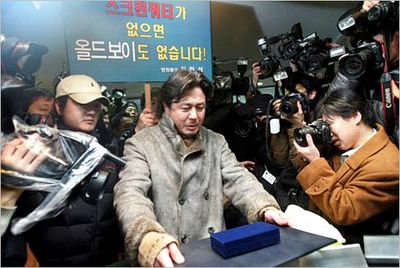
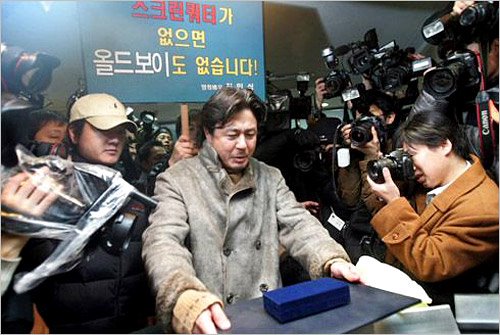
Today's second item is a story from Labourstart Korea's newsire and is on Korean movie stars and filmakers protesting South Korea's plans to abolish its screen quota as part of their bilateral free trade agreement with the United States. On Monday, South Korea's top movie star, Jang Dong-gun, held a one-man protest at the Gwanghwamun intersection in downtown Seoul. Choi Min-shik, another well-known film star and my personal favorite, held his own protest there on Tuesday, returning a government medal he had recieved for his work.
Finally, Kotaji has a link to an article in this month's ISJ about some recent writing on NK by the Korean internationalist left, and written by Kotaji himself. Should be a good read, I can't wait to get to it myself.
First, here's an interesting article in yesterday's Choson Ilbo about pressure from the All China Federation of Trade Unions for a collective bargaining agreement at Hyundai's China operation. Very interesting indeed. I'm really not sure what this spells out for the future of working class organization in China, but it is very signficant because it seems that something is indeed going on in regards to skilled labour there. There is indeed a level of repression against popular protest in China, but if it is to deserve the developmental state label which it has lately been garnering, the existence of collective bargaining structure would run against our conventional understanding of labour as demobilized within that model. Could the ACFTU be heading down a social corporatist path? It's too early to tell. I'm also curious what this means for workers in India, where Hyundai motors is expected to roll out its millionth car this month. The threat of more docile labour to be found in China may be running out.
Today's second item is a story from Labourstart Korea's newsire and is on Korean movie stars and filmakers protesting South Korea's plans to abolish its screen quota as part of their bilateral free trade agreement with the United States. On Monday, South Korea's top movie star, Jang Dong-gun, held a one-man protest at the Gwanghwamun intersection in downtown Seoul. Choi Min-shik, another well-known film star and my personal favorite, held his own protest there on Tuesday, returning a government medal he had recieved for his work.
Finally, Kotaji has a link to an article in this month's ISJ about some recent writing on NK by the Korean internationalist left, and written by Kotaji himself. Should be a good read, I can't wait to get to it myself.
Friday, February 03, 2006
Reunification: maybe?
Below I'm reprinting some recent testimony to the US congress from Christine Ahn, of the US based Oakland Institute, on Korean reunification. I'm not exactly sure which committee she was testifying to or its significance, but it think it provides a nice general overview as well as personal and anecdotal account of some of the changing moods in South Korea toward the North, though it might perhaps read a bit rosier than others might have put it, glossing over some of the current complexities of political power on both ends the pennisula. Click 'view full posting' to read the article.
Good Morning America, Korea is Reunifying
by Christine Ahn
January 31, 2006
On my recent trip to South Korea last November, I was struck by how much reunification was in the air. I first got this impression as I waited at customs at Incheon International Airport. Looming above me were large flat screen TVs beaming a Samsung cell phone commercial with two of Korea’s most popular female stars, South Korea’s pop icon Lee Hyo-Ri and North Korean dancer Jo Myung-Ae. In the commercial, the two superstars sing a song about parted lovers, and the lyrics go something like, “Someday we will meet again, although no one knows where we’re going, someday we will meet again, in this very image of us separated.” As they hold hands during the concert, the new blue One Korea peninsula flag rolls down behind them. As they turn to watch the flag, Lee Hyo-Ri’s voice says in the background, “That day I was so nervous…because the story wasn’t just about the two of us.”
Here was Samsung, one of Korea’s most powerful corporations, popularizing reunification. But the South Korean government was also sending a clear message to all foreigners landing on Korean soil: reunification is happening, slowly, but surely.
When I told my young South Korean friend how emotional I felt as a Korean-American watching that commercial, he said that even before it was broadcast, Koreans were talking about it all over the internet. He also told me that nearly all blockbuster films in South Korea are about the Korean War, North Korea or reunification, and that North Korean characters are now humanized, compared with a few years ago when they only appeared as villains. One such film, Taegukki, a revisionist historical film about the war, still holds the number one spot in ticket sales. Eleven out of 50 million South Koreans, or 1 in 5, have seen Taeguki. Reunification is happening, my friend said, and no one—not even the election of a conservative South Korean president—will be able to turn the tide.
Another major cultural icon, Cho Yong Pil, considered the most popular singer for the past 25 years has also helped influence popular perceptions about North Korea. Several years ago, I asked him what he thought about reunification, and he told me it could not be achieved until the elders passed due to the deep pain they still harbored from the Korean War. To my surprise, last August, he performed a concert in Pyongyang. Many South Koreans told me this was huge, more than a South Korean president visiting North Korea, because he is so beloved by every Korean irrespective of age, class, religion, or ideology.
Public Opinion Polls
Although these may seem like random examples, they actually correspond with recent public opinion polls taken in South Korea. The Korea Institute for National Unification, or KINU, a national research policy institute, recently conducted a public opinion poll of 1000 South Koreans citizens and 300 leaders from political, media and civil organizations. It found that 84 percent of the public and 96 percent of opinion leaders believed that unification was an urgent task for the nation, and 85 percent of the general public and 95 percent of opinion leaders approved of North-South economic cooperation.
Political, Cultural, Economic Exchanges
Although complete reunification may still be a distant dream, Koreans from the North and South are taking measured steps towards realizing it. On June 17, the South Korean Minister of Unification met North Korean leader Kim Jong Il and urged North Korea to return to the six-way talks. In return, South Korea promised to give North Korea two million kilowatts of electricity, the amount that would have been generated by the two light water reactors promised by the United States under the 1994 Agreed Framework.
For the five-year anniversary of the June 15 declaration, hundreds of Koreans from around the world convened in North Korea to celebrate the achievements made towards reunification. And on August 15th, on the 60th anniversary of liberation from Japan, dozens of Koreans gathered in the north to commemorate this important date.
Tourism has also been booming in North Korea. In 2005, over 275,000 South Korean tourists visited Mt. Kumgang resort in North Korea, bringing the total to over 1.1 million. That year, over 10,000 Koreans, not counting tourists, had social and cultural exchanges in the north, a doubling from 2002 to 2004, when an average of 5,000 Koreans met per year. Together, they reconstructed Buddhist temples and Christian churches, and held meetings to discuss intellectual property rights of literature and a common dictionary. Last year, North Koreans watched a South Korean opera, and this year, South Koreans will watch “Sa-yuk-shin,” a North Korean drama on TV.
Perhaps the most emotional aspect of this historic process is the meeting of families, many who have not seen their relatives in over 50 years. Last year, 660 separated family members were reunited in person, and 800 family members were able to see and speak to each other through webcast, a new technology that has helped the elderly who can no longer travel far distances.
And if there is any indication of how the South Korean business community feels about reunification, let’s just say that South Koreans are putting money where their mouths are. Economic exchange between North and South Korea grew almost 60 percent in one year, exceeding $875 million in 2005. And just from the Kaesong joint-industrial zone, over $11 million of manufactured goods were exported to South Korea in 2005, including steel pots and pans, which sold out in 19 minutes once they hit Seoul’s department stores. This trade will only increase once the Trans-Korean railway project is complete. But it won’t be only transporting goods. Koreans from Seoul will be able to travel through Pyongyang to Beijing for the 2008 Olympics, where Koreans will play as a unified team. Personally, I wouldn’t want to coach that team, but I can tell you that I will for sure be on that train!
Others engaging North Korea
In addition to normalizing relations with South Korea in 2000, North Korea also signed a treaty with Russia, and in 2004 established diplomatic relations with the EU. A New York Times article, “North Korea is Reaching Out to the World, and the World is Reaching Back,” documents how North Korea now has embassies in 41 countries and diplomatic ties with 155 nations.
And it’s not just governments that are engaging North Korea. Last fall, the Swiss pharmaceutical giant Novartis announced plans to build a plant in North Korea to manufacture 50 medical products and train North Korean medical staff overseas.
Foreigners investing in North Korea may seem like news to most of the world, but this was the sense I got when I visited North Korea in the summer of 2004. Our peace and humanitarian aid delegation stayed at the Koryo Hotel, Pyongyang’s finest, and in the lobby and dining room, and on the elevator, I was surprised to see so many foreigners from Europe, China, Japan, and South Korea. Clearly, the 2002 economic reforms North Korea implemented are finally attracting the foreign investment they need.
Conclusion
In the summer of 2004, Korean soldiers on both sides of the DMZ began to dismantle loudspeakers used for decades to broadcast government propaganda against the other side. South Koreans flashed “peace and reunification” before they went off for good.
Despite meaningful progress between the two Koreas, the Korean peninsula as understood by the international order is caught between the past and present. Sour relations between Pyongyang and Washington are in a stalemate, and are causing a rift between South-U.S. relations. Koreans, seeing the significant gains in peace and reunification, are no longer willing to accept America’s Cold War mentality. On January 18th, the Journalist Association of Korea, the largest journalist group with 6,000 members, asked U.S. ambassador Alexander Vershbow to “stop making anti-North Korean remarks that do more harm than good,” and to apologize for his remarks, which they viewed as “an intrusion in domestic affairs.” South Korean President Roh Moo Hyun also recently made clear that he did not endorse U.S. sanctions against North Korea. If the Bush administration continues hostile regime change policies, Roh said, “there will be friction and disagreements between Seoul and Washington.”
If the United States genuinely wants peace and human rights for the Korean people, then U.S.-Korea policy should reflect this aspiration. Concretely, the United States should sign a non-aggression pact with North Korea, lift economic sanctions, minimize hostile rhetoric towards the north, and support the Korean people’s efforts towards reunification.
It was just my parents’ generation when the Korean War happened. Although it might be called the “Forgotten War” in the U.S., Koreans are still divided as a legacy of that war. As a Korean American, I feel especially responsible because I live in the United States, and as an American citizen, I want America to be part of the solution, not part of the problem. Nobody could have imagined Korea’s phenomenal progress just a few years ago. Just like Germany in the 1980s, nobody dreamed that East and West Germany would reunite, but it happened overnight. Strong popular desire for reunification was key, as were cultural ties that helped build trust between the two societies. Those who doubt Korean reunification should now be reminded that there were doubters back then too. Let’s bring America along with the rest of the world and chart a new Korea policy that finally ends the Korean War and secures permanent peace for Koreans.
This is an abridged version of Christine Ahn's Congressional testimony on January 25, 2005. Ahn is a member of Korean-Americans United for Peace and an Oakland Institute Fellow.
Good Morning America, Korea is Reunifying
by Christine Ahn
January 31, 2006
On my recent trip to South Korea last November, I was struck by how much reunification was in the air. I first got this impression as I waited at customs at Incheon International Airport. Looming above me were large flat screen TVs beaming a Samsung cell phone commercial with two of Korea’s most popular female stars, South Korea’s pop icon Lee Hyo-Ri and North Korean dancer Jo Myung-Ae. In the commercial, the two superstars sing a song about parted lovers, and the lyrics go something like, “Someday we will meet again, although no one knows where we’re going, someday we will meet again, in this very image of us separated.” As they hold hands during the concert, the new blue One Korea peninsula flag rolls down behind them. As they turn to watch the flag, Lee Hyo-Ri’s voice says in the background, “That day I was so nervous…because the story wasn’t just about the two of us.”
Here was Samsung, one of Korea’s most powerful corporations, popularizing reunification. But the South Korean government was also sending a clear message to all foreigners landing on Korean soil: reunification is happening, slowly, but surely.
When I told my young South Korean friend how emotional I felt as a Korean-American watching that commercial, he said that even before it was broadcast, Koreans were talking about it all over the internet. He also told me that nearly all blockbuster films in South Korea are about the Korean War, North Korea or reunification, and that North Korean characters are now humanized, compared with a few years ago when they only appeared as villains. One such film, Taegukki, a revisionist historical film about the war, still holds the number one spot in ticket sales. Eleven out of 50 million South Koreans, or 1 in 5, have seen Taeguki. Reunification is happening, my friend said, and no one—not even the election of a conservative South Korean president—will be able to turn the tide.
Another major cultural icon, Cho Yong Pil, considered the most popular singer for the past 25 years has also helped influence popular perceptions about North Korea. Several years ago, I asked him what he thought about reunification, and he told me it could not be achieved until the elders passed due to the deep pain they still harbored from the Korean War. To my surprise, last August, he performed a concert in Pyongyang. Many South Koreans told me this was huge, more than a South Korean president visiting North Korea, because he is so beloved by every Korean irrespective of age, class, religion, or ideology.
Public Opinion Polls
Although these may seem like random examples, they actually correspond with recent public opinion polls taken in South Korea. The Korea Institute for National Unification, or KINU, a national research policy institute, recently conducted a public opinion poll of 1000 South Koreans citizens and 300 leaders from political, media and civil organizations. It found that 84 percent of the public and 96 percent of opinion leaders believed that unification was an urgent task for the nation, and 85 percent of the general public and 95 percent of opinion leaders approved of North-South economic cooperation.
Political, Cultural, Economic Exchanges
Although complete reunification may still be a distant dream, Koreans from the North and South are taking measured steps towards realizing it. On June 17, the South Korean Minister of Unification met North Korean leader Kim Jong Il and urged North Korea to return to the six-way talks. In return, South Korea promised to give North Korea two million kilowatts of electricity, the amount that would have been generated by the two light water reactors promised by the United States under the 1994 Agreed Framework.
For the five-year anniversary of the June 15 declaration, hundreds of Koreans from around the world convened in North Korea to celebrate the achievements made towards reunification. And on August 15th, on the 60th anniversary of liberation from Japan, dozens of Koreans gathered in the north to commemorate this important date.
Tourism has also been booming in North Korea. In 2005, over 275,000 South Korean tourists visited Mt. Kumgang resort in North Korea, bringing the total to over 1.1 million. That year, over 10,000 Koreans, not counting tourists, had social and cultural exchanges in the north, a doubling from 2002 to 2004, when an average of 5,000 Koreans met per year. Together, they reconstructed Buddhist temples and Christian churches, and held meetings to discuss intellectual property rights of literature and a common dictionary. Last year, North Koreans watched a South Korean opera, and this year, South Koreans will watch “Sa-yuk-shin,” a North Korean drama on TV.
Perhaps the most emotional aspect of this historic process is the meeting of families, many who have not seen their relatives in over 50 years. Last year, 660 separated family members were reunited in person, and 800 family members were able to see and speak to each other through webcast, a new technology that has helped the elderly who can no longer travel far distances.
And if there is any indication of how the South Korean business community feels about reunification, let’s just say that South Koreans are putting money where their mouths are. Economic exchange between North and South Korea grew almost 60 percent in one year, exceeding $875 million in 2005. And just from the Kaesong joint-industrial zone, over $11 million of manufactured goods were exported to South Korea in 2005, including steel pots and pans, which sold out in 19 minutes once they hit Seoul’s department stores. This trade will only increase once the Trans-Korean railway project is complete. But it won’t be only transporting goods. Koreans from Seoul will be able to travel through Pyongyang to Beijing for the 2008 Olympics, where Koreans will play as a unified team. Personally, I wouldn’t want to coach that team, but I can tell you that I will for sure be on that train!
Others engaging North Korea
In addition to normalizing relations with South Korea in 2000, North Korea also signed a treaty with Russia, and in 2004 established diplomatic relations with the EU. A New York Times article, “North Korea is Reaching Out to the World, and the World is Reaching Back,” documents how North Korea now has embassies in 41 countries and diplomatic ties with 155 nations.
And it’s not just governments that are engaging North Korea. Last fall, the Swiss pharmaceutical giant Novartis announced plans to build a plant in North Korea to manufacture 50 medical products and train North Korean medical staff overseas.
Foreigners investing in North Korea may seem like news to most of the world, but this was the sense I got when I visited North Korea in the summer of 2004. Our peace and humanitarian aid delegation stayed at the Koryo Hotel, Pyongyang’s finest, and in the lobby and dining room, and on the elevator, I was surprised to see so many foreigners from Europe, China, Japan, and South Korea. Clearly, the 2002 economic reforms North Korea implemented are finally attracting the foreign investment they need.
Conclusion
In the summer of 2004, Korean soldiers on both sides of the DMZ began to dismantle loudspeakers used for decades to broadcast government propaganda against the other side. South Koreans flashed “peace and reunification” before they went off for good.
Despite meaningful progress between the two Koreas, the Korean peninsula as understood by the international order is caught between the past and present. Sour relations between Pyongyang and Washington are in a stalemate, and are causing a rift between South-U.S. relations. Koreans, seeing the significant gains in peace and reunification, are no longer willing to accept America’s Cold War mentality. On January 18th, the Journalist Association of Korea, the largest journalist group with 6,000 members, asked U.S. ambassador Alexander Vershbow to “stop making anti-North Korean remarks that do more harm than good,” and to apologize for his remarks, which they viewed as “an intrusion in domestic affairs.” South Korean President Roh Moo Hyun also recently made clear that he did not endorse U.S. sanctions against North Korea. If the Bush administration continues hostile regime change policies, Roh said, “there will be friction and disagreements between Seoul and Washington.”
If the United States genuinely wants peace and human rights for the Korean people, then U.S.-Korea policy should reflect this aspiration. Concretely, the United States should sign a non-aggression pact with North Korea, lift economic sanctions, minimize hostile rhetoric towards the north, and support the Korean people’s efforts towards reunification.
It was just my parents’ generation when the Korean War happened. Although it might be called the “Forgotten War” in the U.S., Koreans are still divided as a legacy of that war. As a Korean American, I feel especially responsible because I live in the United States, and as an American citizen, I want America to be part of the solution, not part of the problem. Nobody could have imagined Korea’s phenomenal progress just a few years ago. Just like Germany in the 1980s, nobody dreamed that East and West Germany would reunite, but it happened overnight. Strong popular desire for reunification was key, as were cultural ties that helped build trust between the two societies. Those who doubt Korean reunification should now be reminded that there were doubters back then too. Let’s bring America along with the rest of the world and chart a new Korea policy that finally ends the Korean War and secures permanent peace for Koreans.
This is an abridged version of Christine Ahn's Congressional testimony on January 25, 2005. Ahn is a member of Korean-Americans United for Peace and an Oakland Institute Fellow.
Monday, January 30, 2006
new feature!
Just in case any of you didn't notice, I've recently added labourstart Korea's newswire (which I also help maintain) to the bottom left corner of our blog. I think it is a good feature as I don't obviously have the time to post on everything that comes up and they often have good daily coverage of events as they unfold. Labourstart also has newsfeeds from a variety of other countries that you can incorporate into your own web pages.
bye bye kim tae hwan
An article appeared in today's Korea Herald titled "Outgoing labour minister a hit with business" that takes a brief look at Kim tae-hwan's career. From the title you can see that he was certainly popular with some. It seems he has been tough on the labour movement, even though he was previously an advisor to it. Seems also that he has done a lot to weaken the benefits enjoyed by regular workers while trying to do something to protect, yet expand, non-regular forms of work. The article points out that this is in tune with an OECD report calling for the government to ease employment protection for regular workers and to provide a social safety net for non regular workers. The OECD report, however, seems more suited to the interests of Transnational Corporations, or domestic chaebol, that aren't too interested in providing high wages or long term benefits for their workers.
The article also seems to think it is a good thing to have set about creating a strict neoliberal labour market, by punishing political strikes by unions and intervening in others. What the article, and perhaps Kim, seem to ignore, however, is the fact that a flexible labour market is perhaps not a particularly desirable outcome for all if by flexibility we mean the enhanced right to hire and fire workers on a whim, or deny them benefits (see article below for some of the criticisms of flexibilization in Korea). Especially in a country without a strong social safety net. The government does deserve some marks in attempting to expand one, it is true, but this comes as a bandaid measure to ease some of the social conflict its labour market already generates and will generate in the future if such forms of job insecurity continue to proliferate. Concepts like flexibilty may sound desirable, as indeed certain forms of job-task and production flexibilty are, but the neoliberal meaning of the word above is not the kind of flexibilty that invests in workers skills or capacities, instead it is the type of flexibity which offers to pay workers less for the jobs they are already doing.
The unions have been pursuing a militant fight against the upcoming labour reform bills however they are also enduring some internal strife of their own. Kotaji has a few recent posts about how this has affected the democratic labour party internal elections, the results, and their aftermath that are worthy to read. Hopeful the labour movement will continue to rebuild and rejuvinate, and perhaps with a more sensitive labour minister for whom expanding precarious and irregular forms of works do not appear as inevitable, or even, necessarily desirable.
The article also seems to think it is a good thing to have set about creating a strict neoliberal labour market, by punishing political strikes by unions and intervening in others. What the article, and perhaps Kim, seem to ignore, however, is the fact that a flexible labour market is perhaps not a particularly desirable outcome for all if by flexibility we mean the enhanced right to hire and fire workers on a whim, or deny them benefits (see article below for some of the criticisms of flexibilization in Korea). Especially in a country without a strong social safety net. The government does deserve some marks in attempting to expand one, it is true, but this comes as a bandaid measure to ease some of the social conflict its labour market already generates and will generate in the future if such forms of job insecurity continue to proliferate. Concepts like flexibilty may sound desirable, as indeed certain forms of job-task and production flexibilty are, but the neoliberal meaning of the word above is not the kind of flexibilty that invests in workers skills or capacities, instead it is the type of flexibity which offers to pay workers less for the jobs they are already doing.
The unions have been pursuing a militant fight against the upcoming labour reform bills however they are also enduring some internal strife of their own. Kotaji has a few recent posts about how this has affected the democratic labour party internal elections, the results, and their aftermath that are worthy to read. Hopeful the labour movement will continue to rebuild and rejuvinate, and perhaps with a more sensitive labour minister for whom expanding precarious and irregular forms of works do not appear as inevitable, or even, necessarily desirable.
Wednesday, January 18, 2006
Pressure on the NHRC
There was an interesting article in the Korea Times yesterday titled "CEO's call for disbanding of National Human Right's Commission." I'll reprint the article below momentarily, but a few comments seem necessary first, however. The NHRC has been trying to get rights of migrants and irregular workers recognized for some time now. Indeed, we've tried to cover some of their proposals on our blog to date, recently with the sit-in in the NHRC office by the MTU, and in the battle over labour flexibilization that the NHRC has weighed in on.
The big five employers groups -- the Federation of Korean Industries (FKI), the Korean Chamber of Commerce and Industry (KCCI), the Korea Federation of Small and Medium Businesses, the Korea International Trade Association and the Korea Employers Federation (KEF) -- were pretty blunt in their message opposing the NHRC's proposals claiming that "[t]he commission’s recommendations only reflect the progressive segment of our society.’’ I guess employer's are mad that their 'retrogressive' views aren't in the document.
Here's the story:
CEOs Call for Disbanding of Human Rights Commission
By Choi Kyong-aeStaff Reporter
Read More...
Korean business leaders Tuesday united to urge the government to reject what they call a labor-friendly set of recommendations by the National Human Rights Commission.
``The commission’s recommendations only reflect the progressive segment of our society,’’ they said in a joint statement after an emergency meeting at Lotte Hotel in downtown Seoul.
They called for the replacement of all 11 members of the commission with those who would ``broadly represent the national sentiment.’’
Their collective action came after the commission last week made its final draft for a ``national action plan’’ for the government to minimize the employment of non-regular workers and reduce its right to intervene and settle labor disputes, among other things.
The government will pick and choose from among the recommendations and make its version to the United Nations by June. Although the government’s proposal will have legal binding force, it is expected to set the tone for the future course of the nation’s labor policy.
As a result, the business leaders risked the wrath of the progressive government and came out in force, issuing a point-by-point rebuttal on the commission’s recommendations.
The statement chided the commission for trying to deal with the issue of non-regular workers from an ideological point of view. ``It is an industrial issue and should be treated as one,’’ it said.
Regarding its call for the removal of the government’s direct intervention, they claimed that it should be preserved as tool to protect the general public from harms that result from strikes in the nation’s key industries such as power stations and transportation systems.
``If these recommendations were accepted, it would trigger a great confusion throughout society,’’ it said.
The five business associations signed on the joint statement. They were the Federation of Korean Industries (FKI), the Korean Chamber of Commerce and Industry (KCCI), the Korea Federation of Small and Medium Businesses, the Korea International Trade Association and the Korea Employers Federation (KEF).
``If the government follows the NHRC proposals, the society will have to shoulder a huge economic burden,’’ FKI chairman Kang Shin-ho said. ``The most urgent task for the management is to create jobs through facility investments and try to narrow the gap between the rich and the poor,’’ KEF chairman Lee Su-young said.
Lee said, however, that their statement didn’t target the government or President Roh Moo-hyun.
The commission’s action plan also called on the government to recognize conscientious objectors and allow teachers and public servants to participate in political activities.
The business community took issue with these recommendations, saying, ``These recommendations, if implemented, would shake the national security to its foundation.’’
During its FKI executives meeting last week, CEOs reached consensus that the business community should more aggressively have its voice heard about social issues as well as economic issues.
However, sources say that the business leaders’ bold action had more to do with an effort to gain an upper hand in their wage negotiations that come in spring or push for their agenda to be reflected in the nation’s roadmap on labor affairs to be finalized soon.
Meanwhile, the government said that Prime Minister Lee Hae-chan will host a meeting with senior officials to deal with the business community’s grievances. ``There are elements that need reconsideration in the commission’s recommendation,’’ a government official said.
The big five employers groups -- the Federation of Korean Industries (FKI), the Korean Chamber of Commerce and Industry (KCCI), the Korea Federation of Small and Medium Businesses, the Korea International Trade Association and the Korea Employers Federation (KEF) -- were pretty blunt in their message opposing the NHRC's proposals claiming that "[t]he commission’s recommendations only reflect the progressive segment of our society.’’ I guess employer's are mad that their 'retrogressive' views aren't in the document.
Here's the story:
CEOs Call for Disbanding of Human Rights Commission
By Choi Kyong-aeStaff Reporter
Read More...
Korean business leaders Tuesday united to urge the government to reject what they call a labor-friendly set of recommendations by the National Human Rights Commission.
``The commission’s recommendations only reflect the progressive segment of our society,’’ they said in a joint statement after an emergency meeting at Lotte Hotel in downtown Seoul.
They called for the replacement of all 11 members of the commission with those who would ``broadly represent the national sentiment.’’
Their collective action came after the commission last week made its final draft for a ``national action plan’’ for the government to minimize the employment of non-regular workers and reduce its right to intervene and settle labor disputes, among other things.
The government will pick and choose from among the recommendations and make its version to the United Nations by June. Although the government’s proposal will have legal binding force, it is expected to set the tone for the future course of the nation’s labor policy.
As a result, the business leaders risked the wrath of the progressive government and came out in force, issuing a point-by-point rebuttal on the commission’s recommendations.
The statement chided the commission for trying to deal with the issue of non-regular workers from an ideological point of view. ``It is an industrial issue and should be treated as one,’’ it said.
Regarding its call for the removal of the government’s direct intervention, they claimed that it should be preserved as tool to protect the general public from harms that result from strikes in the nation’s key industries such as power stations and transportation systems.
``If these recommendations were accepted, it would trigger a great confusion throughout society,’’ it said.
The five business associations signed on the joint statement. They were the Federation of Korean Industries (FKI), the Korean Chamber of Commerce and Industry (KCCI), the Korea Federation of Small and Medium Businesses, the Korea International Trade Association and the Korea Employers Federation (KEF).
``If the government follows the NHRC proposals, the society will have to shoulder a huge economic burden,’’ FKI chairman Kang Shin-ho said. ``The most urgent task for the management is to create jobs through facility investments and try to narrow the gap between the rich and the poor,’’ KEF chairman Lee Su-young said.
Lee said, however, that their statement didn’t target the government or President Roh Moo-hyun.
The commission’s action plan also called on the government to recognize conscientious objectors and allow teachers and public servants to participate in political activities.
The business community took issue with these recommendations, saying, ``These recommendations, if implemented, would shake the national security to its foundation.’’
During its FKI executives meeting last week, CEOs reached consensus that the business community should more aggressively have its voice heard about social issues as well as economic issues.
However, sources say that the business leaders’ bold action had more to do with an effort to gain an upper hand in their wage negotiations that come in spring or push for their agenda to be reflected in the nation’s roadmap on labor affairs to be finalized soon.
Meanwhile, the government said that Prime Minister Lee Hae-chan will host a meeting with senior officials to deal with the business community’s grievances. ``There are elements that need reconsideration in the commission’s recommendation,’’ a government official said.
Monday, January 09, 2006
More WTO follow-up
Just a quick post for today: The KCTU is preparing to send up to 1000 protestors to Hong Kong to demand the release of the 11 South Korean protestors still in jail there. Read more about it in the Choson here and Joongang Daily here. Here's an interview and some audio from a WTO protestor, Joel Wainwright, who was with the Korean contingent there in December, it's worth a listen.
Update -- Seems that all but three of the WTO protestors have been released. Here's is an article on who they are from the HK Standard. Meanwhile, Kotaji has some links to some commentary on the issue from the blogosphere and beyond.
Update -- Seems that all but three of the WTO protestors have been released. Here's is an article on who they are from the HK Standard. Meanwhile, Kotaji has some links to some commentary on the issue from the blogosphere and beyond.
Thursday, January 05, 2006
New Year Labour Update
Here's a brief on some changes to Korean labour relations for this year. Most of are somewhat minor adjustments except for the legalization of civil service unions (something that has been promised since 1997) which will be provide with rights to collectively bargain, but not to strike. The big issue of irregular work expansion seems shelved for the moment but will come up again in the spring. Seems like they couldn't find time to pass it after the large protests on the issue last month as well as the controversy stemming from rice market policy that passed and the deaths of two demonstrators. Thus, the big news here is a series of resignations. National Police Commisioner Huh Joon-young has resigned as has Labour Minister Kim Dae Hwan resigned. The labour movement had been calling for his resignation since last spring in the wake of severe measure taken against irregular worker's strikes.
A longer story on the Migrant's Trade Union recently appeared in the Korea Times which is worth a read to bring readers up to date on the MTU's campaigns. Migrant activism has been increasing again recently following on the footheels of the 'Masok incident' in mid-October when migrants and locals stopped a crackdown by surrounding immigration buses for 9 hours and negotiating the release of a number of the detained migrants (see video and pics). The Times article also discusses the sit-in at the KNHRC that we covered in December.
Update:
Devon wrote a detailed description of the Masok incident over at her blog:
A longer story on the Migrant's Trade Union recently appeared in the Korea Times which is worth a read to bring readers up to date on the MTU's campaigns. Migrant activism has been increasing again recently following on the footheels of the 'Masok incident' in mid-October when migrants and locals stopped a crackdown by surrounding immigration buses for 9 hours and negotiating the release of a number of the detained migrants (see video and pics). The Times article also discusses the sit-in at the KNHRC that we covered in December.
Update:
Devon wrote a detailed description of the Masok incident over at her blog:
Immigration pulls into Maseok [on the afternoon of October 19] to round up as many illegal folk as they can get their hands on. They had successfully herded 31 people onto the bus when something miraculous happened: The residents and business owners in Maseok surrounded the bus and refused to let Immigration take the workers away. It turned into a 10 hour standoff. Sometime during the 10th hour, while MTU folks were furiously calling solidarity groups to come to Maseok and join the fight against Immigration, something else, that wasn't so miraculous, happened: The local leader of a group called JCMK, a reverend, stepped up and started negotiating with Immigration. In the end, Immigration drove the bus, all 31 migrants aboard, straight to Hwaseong Detention Center with the promise that they'd all be let go. Well, who the hell ever trusts the government, anyhow? I mean, really- when have they ever lived up to a promise like that? Any government in any country? So as any of us might have predicted, there was a catch: 22 of the 31 were out of detention by Thursday- with conditions. They were bonded, meaning they had to pay the government 500,000 won (about $500) as a sort of security deposit, and they had to buy a plane ticket out of the country with the promise to leave in no more than 14 days. Immigration threatened to sanction the employers in Maseok if all of the conditions weren't met to their satisfaction. The other 9 workers will be deported immediately because they don't have valid passports.
Read More...
I guess some people might view this as a victory. After all, the 22 people who were let out of detention have most certainly left Maseok to seek work in some other little industrial zone in Nowhere, Korea- out of the view of immigration- at least for a little while. But I am personally a bit miffed at the outcome. Here's why: the JCMK reverend negotiated with the full faith of the local community without actually consulting folks, and then convinced everyone that it would be okay, it's just really important to follow the law. Who knows, maybe people were prepared to hang out there for 24 hours, or 24 days until their demands were met. Perhaps, in this spontaneous spark of community solidarity, a really meaningful fight could've been waged against the unfair employment laws and really brought immigration policy into focus for the rest of Korea. This little bitty town in the middle of nowhere could've been the push the migrant's needed to gain a little respect in their fight for equality. It is completely possible that every single one of those workers could've been freed without ever having gone to the detention center in the first place. But they weren't.
And so this is what brings me to Maseok: I wanted to see for myself what was going on there. Right now, it is a very delicate political situation for MTU. They need to organize to get rid of the unfair immigration law called EPS, but for the moment, the reverend is a hero in Maseok. He apparently single-handedly freed 22 workers while, in his view, MTU stood by impotently. This reverend, as it turns out, also happens to fully support EPS, which has resulted in thousands upon thousands arrests and deportations since it's implementation, as well as has increased the number of people who work illegally in Korea. It's a crime the way the Korean government hunts down workers they need to keep communities like Maseok thriving- only to bring more workers in the country who, under this law, will inevitably become illegal in the not so distant future.
So MTU is in a bit of a bind. They need to have a strong presence in Maseok without being too strong. They need to organize without pissing off the JCMK, which also in some ways holds the workers and business community hostage because of their clout with politicians. The message from JCMK is: We'll help you, but it's going to be our way and we might not actually ask you about what you really want or need because without us, you couldn't do it. Which isn't actually true, but they've been effective at getting that message across. Isn't the road to hell paved with good intentions?
Campaign to release remaining WTO prisoners
Here's an appeal from an international campaign to free the remaining WTO protestors that came out today. I'll reprint it in full:
International Campaign for the Immediate Release of WTO Political Prisoners
(Sponsoring organizations: Korean Struggle Mission---Korean Confederationof Trade Unions, Korean Peasants League, and Korean Catholic FarmersAssociation---Hong Kong Confederation of Trade Unions, Hong Kong People’sAlliance, and Via Campesina)
Background
During the 6th World Trade Organization Ministerial Conference that washeld in Hong Kong from December 13 to 18, 2005, thousands of participantsrepresenting trade unions and labor rights groups, peasant’s, civil society, migrant rights, and women’s organizations, and social movement organizations participated in a series of peaceful protests, rallies, andother actions to protest the WTO and its impact on workers, farmers, and people all around the world, specifically in developing countries.On the eve of the conclusion of the WTO Ministerial meetings (December17), these groups realized that despite their many efforts, to express their concerns and have their voices heard, the so-called representativesof the people continuously refused to listen.
Read More...
Government officials and trade analysts had cloistered themselves in the convention center pushing forward to achieve some sort of consensus and finalize an agreement that would once again clearly favor developed countries, fail to alleviate poverty, and further increase the gap between the rich and poor.As rally participants attempted to make their way to the convention center, the Hong Kong police forcibly blocked them. Knowing that this could be their last chance, the participants decided to move forward. Although the Hong Kong police attempted to disperse the crowd, the participants were desperate to enter the convention site. They became increasingly frustrated by the efforts of the Hong Kong police to stop and silence them and as a result a confrontation ensued between the participants and the Hong Kong police.
Hong Kong Police Violations Against Demonstrators
During this confrontation the police used excessive force, pepper spray, tear gas, and more importantly anti-riot beanbags (rubber bullets) to stopthe participants. It was recently revealed that the Hong Kong police had never used beanbag bullets on demonstrators in Hong Kong, and that theyare only intended to be used against rioters. It should be noted that theparticipants in no way started a riot nor was it their intention to do so. The intentions of their actions were peacefully motivated and thus, the response of the police in no way warranted such drastic actions. As a consequence many were injured during the confrontation.Little past midnight on December 18, the Hong Kong police surrounded theprotestors and refused to let anyone to either enter or leave the cordonedarea. Starting at 2:30 am, the police declared that everyone wasparticipating and an “unlawful assembly” and began to systematicallyarrest more than 1,300 participants. Since the police did not have sufficient vans to transfer the participants, it took them over ten hoursto arrest everyone and incarcerate them in 14 detention centers acrossHong Kong. During the arresting and detention process a number were beaten by thepolice, hundreds were forced to be handcuffed in plastic cable wires behind their backs for more than three hours waiting to be processed bythe police at the detention centers, and in certain cases, in the earlystages of the detention, women were strip searched. A large number ofdetainees were held for 48 hours, the legal time frame for the Hong Kongpolice to either charge those arrested or release them. During this timemany participants, in some cases 20 people together, were forcibly crampedinto 3x3 cells with no blanket to cover the cold cement floors.
14 WTO Political Prisoners
In the end, the Hong Kong government released all of the participantsexcept 14 individuals who they deemed to be the ringleaders and thus responsible for damages to public property and injuries suffered by the Hong Kong police. Of the fourteen arrested, nine are South Korean farmers, two are members of the Korean Confederation of Trade Unions (KCTU), one is a homeless rights activist in Japan, one is a Taiwanese student, and one is mainland Chinese. Although the 14 WTO Political Prisoners are out on bail, twelve of the defendants (eleven Korean and one Japanese) are currently living in a local church due to the generosity ofthe Hong Kong Catholic Bishop, awaiting their trial. It should be noted that this is the first time that foreign nationals have been charged and are undergoing a formal trial procedure for participating in actions against the WTO.
Hunger Strike Launched by the WTO Political Prisoners
12 of the 14 WTO Political Prisoners have decided to launch an indefinite hunger strike starting January 5 to not only highlight the injustice oftheir case, but more importantly highlight the reason for them coming toHong Kong---to protest against the WTO. Their fight was not with thepeople of Hong Kong, but with the undemocratic institution of the WTO andthe free trade policies implement by the WTO without any real consultation with workers and farmers.
Call for Action
We are calling for the international community to express your outrage tothe Hong Kong government and the Hong Kong police by calling for the immediate release of the 14 WTO political prisoners. We are asking individuals and organizations to participate in a variety of activitiesthat we are launching in conjunction with the Hunger Strike by the WTO Political Prisoners.
WHAT YOU CAN DO
1.International Support Letter Writing CampaignWrite to Donald Tsang calling for the immediate release of the 14 WTOPolitical Prisoners. Please see the enclosed sample letter. Send copiesof all letters to the International Committee for the Immediate Release ofthe WTO political prisoners at antiwto2005@naver.com andhkpa.documentation@gmail.com.
2.Coordinate an International Day of ActionWe are calling for interested organizations and individuals to coordinatea protest rally in front of the Chinese Embassy on Monday, January 9, 2006at 12:00 pm. In addition to the rally, we urge people to meet withembassy officials calling for the immediate release of the 14 WTOPolitical PrisonersPlease send all information of international day of actions toantiwto2005@naver.com and hkpa.documentation@gmail.com.
3.Participate in an Internal Solidarity Mission to Hong Kong.We are coordinating an international delegation consisting of key leadersfrom trade unions, human rights groups, civil society organizations, peasant’s groups, and other social movements to participate in asolidarity mission to Hong Kong. The program will start with a localrally coordinated by Hong Kong support groups on January 8, participatingin the international day of action and press conference on January 9,visiting key members within the Hong Kong government and the prosecutionon January 10 and ending with observing the pre-trial hearing scheduled for January 11. For more information about the International Solidarity Mission, pleasecontact Elizabeth Tang. of the HKCTU at 852-9091-9088 and Jin Sook Lee ofthe KCTU at 852-6733-83954.
4.Solidarity Hunger Strike We are calling for individuals and organizations to conduct a solidarityhunger strike for either one meal or one day anytime between January 5 to11, 2006.Please send all information of solidarity hunger strike toantiwto2005@naver.com and hkpa.documentation@gmail.com.
5.Financial SupportWe appeal for financial support towards the expenses that the detaineeshave incurred as a result of the detention. Donations can be sent to HKBS001-393248-001 or by cheques payable to Student Christian Movement of HongKong. Please send cheques to Mr. Chan Chiu Wai at 7/F Wing Wong Building557-559 Nathan Road Kowloon, Hong Kong. Be sure to note on the cheque that the donation is "support for arrested WTO protestors".
Sample Letter
Mr. Donald Tsang
Chief Executive
Special Administrative Region of Hong Kong People's Republic of China
Via fax: 852-2509-0577 or Via e-mail ceo@ceo.gov.hk
January 4, 2006
Dear Chief Executive Tsang:
On behalf of ________, I am writing to express our deep concerns about thearrest of 14 protestors from South Korea, Japan, Taiwan, and mainlandChina, who are facing charges of unlawful assembly for the events thattranspired on the December 17, 2005 near the vicinity of the 6th WorldTrade Organization’s Ministerial Conference site in Hong Kong.The 14 protestors charged were among more than 1,300 people arrested onthe night of December 17 questioning the on-going negotiations within theconference site, which would undoubtedly be detrimental to the livelihoodof farmers, workers, and people around the world. The protestors wereattempting to voice their frustration and desperation at yet another roundof the WTO Ministerial conference that yielded no measures to alleviatepoverty or to address their concerns.Although all fourteen are released on bail, it is our understanding thatthe Hong Kong government has formally charged them with “unlawfulassembly” and they are considering adding new charges. We are veryconcerned by the actions of the Hong Kong government and the police. Thus, we strongly call for the immediate release of the 14 protestors sothat they can return home to their families.We must also voice our serious concerns at the uncalled for and excessiveuse of force by the Hong Kong Police during the night of the 17th. Manywere injured, and electric shock batons were used, while reports of‘beanbags pellets’ being fired upon have also been confirmed. We havebeen told that there were numerous instances of human rights violationsduring the process of detaining over 1,300 protestors that have beendocumented by human rights organizations. We urge that an impartial andthorough inquiry into the human rights violations and the violence used onthe part of the Hong Kong police be pursued.As concerned __________ regarding this matter, we would like to point outthat a failure to properly investigate and rectify human rights violationswould reflect negatively on the human rights standards of the SpecialAdministrative Region of Hong Kong. A harsh sentence for the 14 wouldalso put into question the democratic tolerance of the region, taking intoaccount that no foreigners have been arrested in previous cases of similardemonstrations.We will continue to monitor closely the proceedings regarding the 14protestors and again stress our call for the immediate release of the 14activists.
We thank you for your attention to this urgent matter.Sincerely,(list of signatories)
CC: Pascal Lamy Fax: 41-22-731-42-06 or enquiries@wto.org
International Campaign for the Immediate Release of WTO Political Prisoners
(Sponsoring organizations: Korean Struggle Mission---Korean Confederationof Trade Unions, Korean Peasants League, and Korean Catholic FarmersAssociation---Hong Kong Confederation of Trade Unions, Hong Kong People’sAlliance, and Via Campesina)
Background
During the 6th World Trade Organization Ministerial Conference that washeld in Hong Kong from December 13 to 18, 2005, thousands of participantsrepresenting trade unions and labor rights groups, peasant’s, civil society, migrant rights, and women’s organizations, and social movement organizations participated in a series of peaceful protests, rallies, andother actions to protest the WTO and its impact on workers, farmers, and people all around the world, specifically in developing countries.On the eve of the conclusion of the WTO Ministerial meetings (December17), these groups realized that despite their many efforts, to express their concerns and have their voices heard, the so-called representativesof the people continuously refused to listen.
Read More...
Government officials and trade analysts had cloistered themselves in the convention center pushing forward to achieve some sort of consensus and finalize an agreement that would once again clearly favor developed countries, fail to alleviate poverty, and further increase the gap between the rich and poor.As rally participants attempted to make their way to the convention center, the Hong Kong police forcibly blocked them. Knowing that this could be their last chance, the participants decided to move forward. Although the Hong Kong police attempted to disperse the crowd, the participants were desperate to enter the convention site. They became increasingly frustrated by the efforts of the Hong Kong police to stop and silence them and as a result a confrontation ensued between the participants and the Hong Kong police.
Hong Kong Police Violations Against Demonstrators
During this confrontation the police used excessive force, pepper spray, tear gas, and more importantly anti-riot beanbags (rubber bullets) to stopthe participants. It was recently revealed that the Hong Kong police had never used beanbag bullets on demonstrators in Hong Kong, and that theyare only intended to be used against rioters. It should be noted that theparticipants in no way started a riot nor was it their intention to do so. The intentions of their actions were peacefully motivated and thus, the response of the police in no way warranted such drastic actions. As a consequence many were injured during the confrontation.Little past midnight on December 18, the Hong Kong police surrounded theprotestors and refused to let anyone to either enter or leave the cordonedarea. Starting at 2:30 am, the police declared that everyone wasparticipating and an “unlawful assembly” and began to systematicallyarrest more than 1,300 participants. Since the police did not have sufficient vans to transfer the participants, it took them over ten hoursto arrest everyone and incarcerate them in 14 detention centers acrossHong Kong. During the arresting and detention process a number were beaten by thepolice, hundreds were forced to be handcuffed in plastic cable wires behind their backs for more than three hours waiting to be processed bythe police at the detention centers, and in certain cases, in the earlystages of the detention, women were strip searched. A large number ofdetainees were held for 48 hours, the legal time frame for the Hong Kongpolice to either charge those arrested or release them. During this timemany participants, in some cases 20 people together, were forcibly crampedinto 3x3 cells with no blanket to cover the cold cement floors.
14 WTO Political Prisoners
In the end, the Hong Kong government released all of the participantsexcept 14 individuals who they deemed to be the ringleaders and thus responsible for damages to public property and injuries suffered by the Hong Kong police. Of the fourteen arrested, nine are South Korean farmers, two are members of the Korean Confederation of Trade Unions (KCTU), one is a homeless rights activist in Japan, one is a Taiwanese student, and one is mainland Chinese. Although the 14 WTO Political Prisoners are out on bail, twelve of the defendants (eleven Korean and one Japanese) are currently living in a local church due to the generosity ofthe Hong Kong Catholic Bishop, awaiting their trial. It should be noted that this is the first time that foreign nationals have been charged and are undergoing a formal trial procedure for participating in actions against the WTO.
Hunger Strike Launched by the WTO Political Prisoners
12 of the 14 WTO Political Prisoners have decided to launch an indefinite hunger strike starting January 5 to not only highlight the injustice oftheir case, but more importantly highlight the reason for them coming toHong Kong---to protest against the WTO. Their fight was not with thepeople of Hong Kong, but with the undemocratic institution of the WTO andthe free trade policies implement by the WTO without any real consultation with workers and farmers.
Call for Action
We are calling for the international community to express your outrage tothe Hong Kong government and the Hong Kong police by calling for the immediate release of the 14 WTO political prisoners. We are asking individuals and organizations to participate in a variety of activitiesthat we are launching in conjunction with the Hunger Strike by the WTO Political Prisoners.
WHAT YOU CAN DO
1.International Support Letter Writing CampaignWrite to Donald Tsang calling for the immediate release of the 14 WTOPolitical Prisoners. Please see the enclosed sample letter. Send copiesof all letters to the International Committee for the Immediate Release ofthe WTO political prisoners at antiwto2005@naver.com andhkpa.documentation@gmail.com.
2.Coordinate an International Day of ActionWe are calling for interested organizations and individuals to coordinatea protest rally in front of the Chinese Embassy on Monday, January 9, 2006at 12:00 pm. In addition to the rally, we urge people to meet withembassy officials calling for the immediate release of the 14 WTOPolitical PrisonersPlease send all information of international day of actions toantiwto2005@naver.com and hkpa.documentation@gmail.com.
3.Participate in an Internal Solidarity Mission to Hong Kong.We are coordinating an international delegation consisting of key leadersfrom trade unions, human rights groups, civil society organizations, peasant’s groups, and other social movements to participate in asolidarity mission to Hong Kong. The program will start with a localrally coordinated by Hong Kong support groups on January 8, participatingin the international day of action and press conference on January 9,visiting key members within the Hong Kong government and the prosecutionon January 10 and ending with observing the pre-trial hearing scheduled for January 11. For more information about the International Solidarity Mission, pleasecontact Elizabeth Tang. of the HKCTU at 852-9091-9088 and Jin Sook Lee ofthe KCTU at 852-6733-83954.
4.Solidarity Hunger Strike We are calling for individuals and organizations to conduct a solidarityhunger strike for either one meal or one day anytime between January 5 to11, 2006.Please send all information of solidarity hunger strike toantiwto2005@naver.com and hkpa.documentation@gmail.com.
5.Financial SupportWe appeal for financial support towards the expenses that the detaineeshave incurred as a result of the detention. Donations can be sent to HKBS001-393248-001 or by cheques payable to Student Christian Movement of HongKong. Please send cheques to Mr. Chan Chiu Wai at 7/F Wing Wong Building557-559 Nathan Road Kowloon, Hong Kong. Be sure to note on the cheque that the donation is "support for arrested WTO protestors".
Sample Letter
Mr. Donald Tsang
Chief Executive
Special Administrative Region of Hong Kong People's Republic of China
Via fax: 852-2509-0577 or Via e-mail ceo@ceo.gov.hk
January 4, 2006
Dear Chief Executive Tsang:
On behalf of ________, I am writing to express our deep concerns about thearrest of 14 protestors from South Korea, Japan, Taiwan, and mainlandChina, who are facing charges of unlawful assembly for the events thattranspired on the December 17, 2005 near the vicinity of the 6th WorldTrade Organization’s Ministerial Conference site in Hong Kong.The 14 protestors charged were among more than 1,300 people arrested onthe night of December 17 questioning the on-going negotiations within theconference site, which would undoubtedly be detrimental to the livelihoodof farmers, workers, and people around the world. The protestors wereattempting to voice their frustration and desperation at yet another roundof the WTO Ministerial conference that yielded no measures to alleviatepoverty or to address their concerns.Although all fourteen are released on bail, it is our understanding thatthe Hong Kong government has formally charged them with “unlawfulassembly” and they are considering adding new charges. We are veryconcerned by the actions of the Hong Kong government and the police. Thus, we strongly call for the immediate release of the 14 protestors sothat they can return home to their families.We must also voice our serious concerns at the uncalled for and excessiveuse of force by the Hong Kong Police during the night of the 17th. Manywere injured, and electric shock batons were used, while reports of‘beanbags pellets’ being fired upon have also been confirmed. We havebeen told that there were numerous instances of human rights violationsduring the process of detaining over 1,300 protestors that have beendocumented by human rights organizations. We urge that an impartial andthorough inquiry into the human rights violations and the violence used onthe part of the Hong Kong police be pursued.As concerned __________ regarding this matter, we would like to point outthat a failure to properly investigate and rectify human rights violationswould reflect negatively on the human rights standards of the SpecialAdministrative Region of Hong Kong. A harsh sentence for the 14 wouldalso put into question the democratic tolerance of the region, taking intoaccount that no foreigners have been arrested in previous cases of similardemonstrations.We will continue to monitor closely the proceedings regarding the 14protestors and again stress our call for the immediate release of the 14activists.
We thank you for your attention to this urgent matter.Sincerely,(list of signatories)
CC: Pascal Lamy Fax: 41-22-731-42-06 or enquiries@wto.org
Monday, January 02, 2006
back from vacation
In case anyone was wondering, the lack of posts lately was because I was away from reliable internet access while on Christmas break. To bring readers up to date, there are a few stories we'll be posting shortly on WTO follow-up, changes in Korean labour relations, and migrant labour issues... Check back soon
Subscribe to:
Posts (Atom)

