
I don't normally reprint or link much to the IMF (no, I'm not talking about the International Metalworker's Federation), but there is a short article over there that I read which I found myself agreeing with in a very mild and mediocre way. The article, Korea: In Search of a New Compact, by Un-Chan Chung, Professor at Seoul National University's School of Economics, shows that some Korean economists themselves are no longer towing the line on free markets. I agree with two of his points, (1) that it important not to make a fetish of liberalization and (2) that economies need some form of regulation and promotion of social needs to grow.
However, Chung is not making a call for a new deal here (even though he does allude to social safety nets), much less does he seem in favor of any democratic socialist alternatives, but it is interesting to note the loss of confidence in free market ideology in recent years by economists, right-wing pundits (here I'm thinking of Fukuyama and not Chung whom seems more of a moderate, perhaps even mild Keynesian), and even CEO's, who have turned to concepts such as trust and social capital in order to explain some of the characteristics that make economies grow -- but by often approaching their solutions in fairly undemocratic and harmful methods (ill advised charity schemes, sloppy wars of intervention, corporate welfare). I think it is very interesting that there has been this turn to supposedly 'external' or social factors to see how markets work. Now if only they would turn to the politics of power and production in society for some deeper insight.
UPDATE: Well it seems that Chung Un Chan, is none other than the former Seoul National University president Chung Un Chan, who seemed prominent in these discussions of a new centrist or a 'third zone' candidate for president as an alternative between URI and the GNP that have been taking place more recently. Hence, from the lightness of his critique in the above article I suppose he isn't much different from other candidates in Uri, except for the fact that his isn't from Uri which was his appeal to begin with. Thus the difference between the liberal Uri, the third zone and perhaps 'the third way' are not so different, increasingly the upcoming election seems to be one between neo-liberalism hard (neo-con and old-con GNP) or soft (liberal DP and old Uri). Then again, then again, as examples of the variety of 'actually existing neoliberalism' might show us, these differences may have serious consequences both economically and geo-politically (to follow some of the logic in yesterday's post).
Monday, June 18, 2007


Saturday, June 16, 2007
The lost decade, Roh Myu Hyun and the Left, Samsung's dodgy ownership
Things seem politically very ripe these days, especially with the twentieth anniversary of the June Uprising which has led to a number of assessments about Korean politics and has brought more attention to the problem of economic inequality.
These factors, combined with the ongoing presidential candidate campaigns make for a lot of interesting news. Though conservative candidates stayed away from commemorations of the uprising, they certainly have tried to weigh in on the dismal economic record of the last ten years and have come to regard it as the the 'lost decade,' which they have come to blame on the incompetence of the ruling 'leftist' forces. Note that they are neither apt to blame the flawed application of either neo-liberal or state-led economic policies (the older model) for this, nor are they apt to suggest strong alternatives. Even the new right does not seem to offer a strong alternative to current economic policies, even though they make so much of dictator Park Chung Hee's legacy.
A recent article in the Hankyoreh quotes key conservatives commenting to this to this effect:
Anyways, you can hear more of Roh's perspective on this debate in a recent long interview he did with Hankyoreh. The interview is interesting because Roh gets defensive about the critique that the actual left have made of his economic policies, which he then tries to make the left responsible for by not coming up with alternatives.
Actually, there seems to be a very strong error of mistaking or making fuzzy exactly what is left and right in Korea these days. For example, some recent editorials by both new rightists and old leftists (most surprisingly, Paik Nak Jung) end up calling for a new centrism. You will find that what happens in these articles, and Roh's comments, is very confusing but comes down to this: the 'right' defines the left on its opinions toward North Korea and activist past but blames them for the current economic woes without analyzing these woes in terms of neo-liberal politics itself -- thus calling for something that is more centrist than the left as a cure (but to move to the center from neoliberalism should mean more to the left in our conventional understanding); the 'left', in this case, and here I mean PNJ, basically seems to accept some of the realities caused by neoliberal economic policies but calls for a centrism based on an attitude for continued engagement with the north. Two very different arguments thus end up calling for something the same thing. So, pardon my pun, what exactly is left in this situation? What are the differences between (new) right and old left here?
Yikes, makes you kind of crazy, the bigger irony is that the right wing column above, enlists Cho Hee Yeon's (who certainly knows why and how he is left) criticism of Roh Myu Hyun's economic policies (which indeed are to the right) to advocate for this centrist alternative (though Cho Hee Yeon himself, and indeed correctly in our conventional understanding, argues for a left project).
It's enough to make your head spin. Basically, what I'm trying to say here is that liberals (and maybe some old, or nationalist, leftists) and new conservatives are fighting over the issues on which there is relatively little disagreement with them in terms of ideology (in practice there are key distinctions I would say, the right are more like the US neo-cons and I don't think they embrace neoliberalism because they believe in it in the way that the liberals do). The left position, however, though so often named here in reference to the liberal Roh government, is actually not presented, or even imagined, except as critique of Roh which can be used to fortify the right wing (so long as it seems Roh rather than neoliberalism is to blame).
Anyways, this could be a lot clearer, but things get messy when you try to put yourself into the head of some of the above editorials.
I think elsewhere it would be good to explore these vicissitudes: obviously there are both hawkish and pro-engagement neo-cons, just as there are leftists and liberals who embrace a TINA (there is no alternative) approach to neo-liberalism and those that devise alternative proposals. Finally, granted, there may be a few rightists out there who actually believe in neoliberalism or state intervention as a genuine philosophy of growth rather than as a way to appeal to business groups in cronyist fashion (I'm least sure of this, however).
...
FYI, on a kind of unrelated note, if you are interested in little more about how parts of the old system survive in the new -- in this case corruption within the family led firms -- you can read a quick column by Kim Jin Bang on Samsung's dodgy ownership structure. In my opinion, this stuff is important because it shows sizable influence of the family conglomerates over the Korean economy (and politics) in general. Unfortunately, this kind of research is often used as an excuse to deepen neo-liberal reform, while myself I think there is an opportunity here to think about how transparency issues such as these can be useful for encouraging different, more democratic forms of corporate structure beyond either family or shareholder controlled organizations. How about a tripartite managed fund as a penalty for dodgy practices or, I'm being cheeky here, in the case of Samsung, since they are so anti-union, I think the assignment of shares to worker and community centered groups would be poetic justice for such malpractice.
These factors, combined with the ongoing presidential candidate campaigns make for a lot of interesting news. Though conservative candidates stayed away from commemorations of the uprising, they certainly have tried to weigh in on the dismal economic record of the last ten years and have come to regard it as the the 'lost decade,' which they have come to blame on the incompetence of the ruling 'leftist' forces. Note that they are neither apt to blame the flawed application of either neo-liberal or state-led economic policies (the older model) for this, nor are they apt to suggest strong alternatives. Even the new right does not seem to offer a strong alternative to current economic policies, even though they make so much of dictator Park Chung Hee's legacy.
A recent article in the Hankyoreh quotes key conservatives commenting to this to this effect:
Rep. Kim Hyeong-oh, the [GNP's] floor leader, said, "For the ten years from 1997 to this year, a so-called left-wing camp has ruled, and we call this period a ‘lost decade.’ During this period, we lost our national identity, future vision, and growth momentum," he said.
Potential candidate Park Geun-hye, a former head of the GNP, has said, "Let’s recover the past ten years through a change of political power.The former president Kim and current president Roh , and other members of the democratic reform camp -- whom I would not label as leftists by the way -- have bounced back that the last decade was not a lost but recovered decade.
Former president Kim, in a June 9 speech to commemorate the pro-democracy movement, also denounced the argument of the ‘lost decade.’ "[The past ten years] is not a ‘lost decade,’ but a ‘recovered decade’ that has let people regain the democracy lost over the preceding half-century," he said.
I'm not going to weigh in deep on these issues just yet (I've got a lot of dissertation work to do at the moment), so I'll just link to things here, but I will say that it is very interesting that neither side has attempted to address head on the flaws of neoliberal economic policy but instead blame it different ruling factions.
For example, Roh also raised the issue of the pro-dictatorship camp responsibility in the 1997 crisis as a counterattack against conservatives but fails to offer very clear reflections on the current problems.
"The economic crisis in 1997 was prompted as old systems under authoritarian rule, such as government-ordered finance and economy, weren’t rapidly reformed and repaired," the president said. "Throughout a perfect change of political power, a perfect democratic government swiftly and thoroughly overcame the crisis."As for myself, I would agree with the first sentence that the old system of authoritarian rule (which had been considerably liberalized by 1994 by the way) was problematic, but that the way in which they were reformed also led strongly to the current economic problems Korea is facing.
Anyways, you can hear more of Roh's perspective on this debate in a recent long interview he did with Hankyoreh. The interview is interesting because Roh gets defensive about the critique that the actual left have made of his economic policies, which he then tries to make the left responsible for by not coming up with alternatives.
Actually, there seems to be a very strong error of mistaking or making fuzzy exactly what is left and right in Korea these days. For example, some recent editorials by both new rightists and old leftists (most surprisingly, Paik Nak Jung) end up calling for a new centrism. You will find that what happens in these articles, and Roh's comments, is very confusing but comes down to this: the 'right' defines the left on its opinions toward North Korea and activist past but blames them for the current economic woes without analyzing these woes in terms of neo-liberal politics itself -- thus calling for something that is more centrist than the left as a cure (but to move to the center from neoliberalism should mean more to the left in our conventional understanding); the 'left', in this case, and here I mean PNJ, basically seems to accept some of the realities caused by neoliberal economic policies but calls for a centrism based on an attitude for continued engagement with the north. Two very different arguments thus end up calling for something the same thing. So, pardon my pun, what exactly is left in this situation? What are the differences between (new) right and old left here?
Yikes, makes you kind of crazy, the bigger irony is that the right wing column above, enlists Cho Hee Yeon's (who certainly knows why and how he is left) criticism of Roh Myu Hyun's economic policies (which indeed are to the right) to advocate for this centrist alternative (though Cho Hee Yeon himself, and indeed correctly in our conventional understanding, argues for a left project).
It's enough to make your head spin. Basically, what I'm trying to say here is that liberals (and maybe some old, or nationalist, leftists) and new conservatives are fighting over the issues on which there is relatively little disagreement with them in terms of ideology (in practice there are key distinctions I would say, the right are more like the US neo-cons and I don't think they embrace neoliberalism because they believe in it in the way that the liberals do). The left position, however, though so often named here in reference to the liberal Roh government, is actually not presented, or even imagined, except as critique of Roh which can be used to fortify the right wing (so long as it seems Roh rather than neoliberalism is to blame).
Anyways, this could be a lot clearer, but things get messy when you try to put yourself into the head of some of the above editorials.
I think elsewhere it would be good to explore these vicissitudes: obviously there are both hawkish and pro-engagement neo-cons, just as there are leftists and liberals who embrace a TINA (there is no alternative) approach to neo-liberalism and those that devise alternative proposals. Finally, granted, there may be a few rightists out there who actually believe in neoliberalism or state intervention as a genuine philosophy of growth rather than as a way to appeal to business groups in cronyist fashion (I'm least sure of this, however).
...
FYI, on a kind of unrelated note, if you are interested in little more about how parts of the old system survive in the new -- in this case corruption within the family led firms -- you can read a quick column by Kim Jin Bang on Samsung's dodgy ownership structure. In my opinion, this stuff is important because it shows sizable influence of the family conglomerates over the Korean economy (and politics) in general. Unfortunately, this kind of research is often used as an excuse to deepen neo-liberal reform, while myself I think there is an opportunity here to think about how transparency issues such as these can be useful for encouraging different, more democratic forms of corporate structure beyond either family or shareholder controlled organizations. How about a tripartite managed fund as a penalty for dodgy practices or, I'm being cheeky here, in the case of Samsung, since they are so anti-union, I think the assignment of shares to worker and community centered groups would be poetic justice for such malpractice.
Thursday, June 14, 2007
Pohang Unionists Released
From the Building and Woodworkers International:
 Yoo Ki Soo, the General Secretary of the Korean Federation of Construction Industry Trade Unions (KFCITU) was released on 23 May 2007 after spending close to ten months in prison for participating in a demonstration in support of the strike conducted by the Pohang local union last August 2007. In addition to Yoo Ki Soo, three members of the Pohang local union - Jin Nam Soo, Ji Kap Ryul, and Chin Kyu Man - were released as well. The four who had originally been sentenced to prison terms of two years to two years and six months were released on probation after the union had appealed the original sentence.
 Although the union is extremely pleased with the release of the four whose only crime appears to be fighting for the right of South Korean construction workers to exercise their right to strike and collective bargaining, the union is mindful of the fact that thirteen trade unionists still remain in prison related to strikes conducted by the Pohang local union in 2006 and the Ulsan local union in 2005. It should be noted that the President of the Pohang local union, Lee Ji Kyung was sentenced to a very long term of three years and six months and it is unlikely that he will be released until 2010.
The union wants to express is gratitude to BWI and its affiliates for their consistent support and requests that you remember the other thirteen still in jail.
[Note] You can read our coverage of last year's Pohang Strike here and here.
Yoo Ki Soo, General Secretary of the KFCITU Released after 10 Months
 Yoo Ki Soo, the General Secretary of the Korean Federation of Construction Industry Trade Unions (KFCITU) was released on 23 May 2007 after spending close to ten months in prison for participating in a demonstration in support of the strike conducted by the Pohang local union last August 2007. In addition to Yoo Ki Soo, three members of the Pohang local union - Jin Nam Soo, Ji Kap Ryul, and Chin Kyu Man - were released as well. The four who had originally been sentenced to prison terms of two years to two years and six months were released on probation after the union had appealed the original sentence.
 Although the union is extremely pleased with the release of the four whose only crime appears to be fighting for the right of South Korean construction workers to exercise their right to strike and collective bargaining, the union is mindful of the fact that thirteen trade unionists still remain in prison related to strikes conducted by the Pohang local union in 2006 and the Ulsan local union in 2005. It should be noted that the President of the Pohang local union, Lee Ji Kyung was sentenced to a very long term of three years and six months and it is unlikely that he will be released until 2010.
The union wants to express is gratitude to BWI and its affiliates for their consistent support and requests that you remember the other thirteen still in jail.
[Note] You can read our coverage of last year's Pohang Strike here and here.
Tuesday, June 05, 2007
What I've been reading

I've been away a bit lately so haven't been doing much posting. I'll try to put up a few things near the end of this week, but for now, here is the link to a series of pieces in the Hankyoreh on the twenty year anniversary of the 1987 June Uprising, enjoy.
Saturday, May 19, 2007
Cheonggye vendors to be displaced again?
I read this story about the displaced Cheonggye vendors who now inhabit the old Dongdaemun Stadium grounds in the Hankyoreh last week. Seems the government has decided to turf them out yet again to make way for a new park proposal.
Anyways, I seemed to recall Christian, of CINA blog fame, wrote a bunch of dispatches from that struggle back in 2004 when the vendors were originally displaced as part of the Cheonggye stream restoration (read: building of world's largest fountain, or pumped in stream). The city hired some kind of mafia to do the actual work of displacement which generated a great deal of public support for the vendors, and the ramshackle idea of accommodating them in the unused stadium, especially after violent confrontations between vendors, police, and hired thugs escalated (video) into the end of November of that year.
Matt, over at gusts of popular feeling, has posted some pics and opinions showing the redevelopment of the area that the vendors used to inhabit, which has proceeded quite quickly since 2004. If I have time in the coming week, I'll try to post a bit on the political economy of redevelopment, which I've tried to discuss a bit on this blog earlier, as more money is sunk into the Seoul property markets and the city creates various projects to attract it. Some people cynically brand this a approach a new style of developmentalism, but as we can see, especially from matt's post and the others, it is one that benefits few.
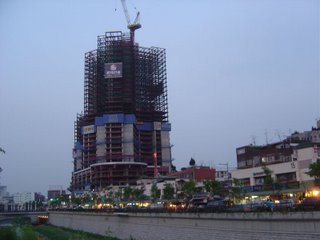
The new Lotto palace going in near where most of the vendors used to work.
For these vendors, the demolition moves represent yet another in a long line of broken promises from the Seoul government. This was not their original place of work: they were moved here from the Hwanghak-dong flea market after former Seoul city mayor Lee Myung-bak implemented a restoration project of the Cheonggye stream in 2003. At that time, the vendors believed the former mayor’s pledge to build a world-renowned flea market. However, the pledge changed shortly after incumbent mayor Oh Se-hoon took office in May last year, as one of Oh’s campaign promises was to build a park and a design center nearby Dongdaemun.The above mentioned flea market idea had been met with a lot of support from both grassroots groups and intellectuals like Cho Myoung Rae, an urban scholar who helps run a research institute on urban issues and city development.
Anyways, I seemed to recall Christian, of CINA blog fame, wrote a bunch of dispatches from that struggle back in 2004 when the vendors were originally displaced as part of the Cheonggye stream restoration (read: building of world's largest fountain, or pumped in stream). The city hired some kind of mafia to do the actual work of displacement which generated a great deal of public support for the vendors, and the ramshackle idea of accommodating them in the unused stadium, especially after violent confrontations between vendors, police, and hired thugs escalated (video) into the end of November of that year.
Matt, over at gusts of popular feeling, has posted some pics and opinions showing the redevelopment of the area that the vendors used to inhabit, which has proceeded quite quickly since 2004. If I have time in the coming week, I'll try to post a bit on the political economy of redevelopment, which I've tried to discuss a bit on this blog earlier, as more money is sunk into the Seoul property markets and the city creates various projects to attract it. Some people cynically brand this a approach a new style of developmentalism, but as we can see, especially from matt's post and the others, it is one that benefits few.
The new Lotto palace going in near where most of the vendors used to work.
Sunday, May 13, 2007
FTA Renegotiation?
Here's the link to a story in the Hankyoreh, seems there is a big possibility that the Kor-US FTA will have to be re-negotiated to better take into consideration a number of labour and environmental issues. Seems like a good chance to bring better attention to other parts of the deal.
Max Baucus, chairman of the U.S. Senate Committee on Finance, said that recent FTAs with four nations including South Korea should contain the five core standards set forth by the International Labor Organization (ILO); namely, the right to organize, the right to bargain collectively, and bans on child labor, forced labor, and employment discrimination.
Tuesday, May 08, 2007
Financial and Industrial Capital, the Chaebol, and the GNP
Here's a very interesting story about one area of agreement between the right wing presidential candidates as well as some particular types of economic nationalists: this is the issue of Chaebol ownership of financial institutions such as banks and other lending bodies. Traditionally, a separation of finance and industry is considered necessary to avoid 'moral hazard' issues that could lead to economic crises. Obviously, for the writers of this blog, the economic areas that we usually discuss issues such as moral hazard are mostly in terms of workplace and societal relations, but for mainstream economists these issues are mostly confined to who owns what. It should be no surprise then that the right wing (and occasionally some former left wing nationalists as well) have come out in support of the chaebol's right to own banks.
Now, some of the chaebol's complaints about reverse discrimination against Korean firms are legitimate in terms of the way in which parts of the banking system were preferrentially sold off to foreign speculative funds to whom Korea's restrictions on voting rights and ownership of financial and non-financial firms did not apply, but it should be remembered that the crucial exception that was made here was between foreign and domestic capital and not between foreign capital vs. the chaebol. A key distinction to keep in mind. The chaebol and the right here are mainly turning a criticism of what was a genuinely bad policy move into something that suits their interests in a way that would give them even more control over resources than they have now.
Jeon Seong-in, a professor of Hongik University, makes an astute comment in the article:
"They are plainly talking about transferring bank ownership to the conglomerates.'' "(The so-called presidential hopefuls) worry about the future of domestic financial industry and cite Lone Star Funds, but this problem was not caused because Lone Star represents foreign capital, but because a bank fell into the hands of a non-financial company. They may have correctly recognized a problem, but it is as if they have come up with the wrong solution. ''
I think this is the right step towards a larger debate on what to do about financial sectors as a whole, at the moment the banking sector is overwhelmingly foreign owned, but even where the government owns banks it runs them in the same way, investing in mostly speculative ventures like mortgage and consumer credit -- though they have now begun privatizing Woori bank which they own the majority stake in at the moment. Here one needs a critique of financial capital and what it does, not simply foreign vs. domestic capital. What could the government do to better allocate funds that create jobs, that don't go to environmentally wasteful investments or corrupt firms, and in way in which the public has more than a modicum of democratic input. Some people think that projects like the Ha Soon fund are the answer here, based upon investment in companies with strong shareholder rights, but I am also skeptical about this too. I would rather see money go to firms that respect their unions and workers or to other redistribution enhancing institutions rather than simply a firm with a good relation to its shareholders. Anyways, that's just my opinion.
Now, some of the chaebol's complaints about reverse discrimination against Korean firms are legitimate in terms of the way in which parts of the banking system were preferrentially sold off to foreign speculative funds to whom Korea's restrictions on voting rights and ownership of financial and non-financial firms did not apply, but it should be remembered that the crucial exception that was made here was between foreign and domestic capital and not between foreign capital vs. the chaebol. A key distinction to keep in mind. The chaebol and the right here are mainly turning a criticism of what was a genuinely bad policy move into something that suits their interests in a way that would give them even more control over resources than they have now.
Jeon Seong-in, a professor of Hongik University, makes an astute comment in the article:
"They are plainly talking about transferring bank ownership to the conglomerates.'' "(The so-called presidential hopefuls) worry about the future of domestic financial industry and cite Lone Star Funds, but this problem was not caused because Lone Star represents foreign capital, but because a bank fell into the hands of a non-financial company. They may have correctly recognized a problem, but it is as if they have come up with the wrong solution. ''
I think this is the right step towards a
 larger debate on what to do about financial sectors as a whole, at the moment the banking sector is overwhelmingly foreign owned, but even where the government owns banks it runs them in the same way, investing in mostly speculative ventures like mortgage and consumer credit -- though they have now begun privatizing Woori bank which they own the majority stake in at the moment. Here one needs a critique of financial capital and what it does, not simply foreign vs. domestic capital. What could the government do to better allocate funds that create jobs, that don't go to environmentally wasteful investments or corrupt firms, and in way in which the public has more than a modicum of democratic input. Some people think that projects like the Ha Soon fund are the answer here, based upon investment in companies with strong shareholder rights, but I am also skeptical about this too. I would rather see money go to firms that respect their unions and workers or to other redistribution enhancing institutions rather than simply a firm with a good relation to its shareholders. Anyways, that's just my opinion.
Sunday, May 06, 2007
Raw deal FTA
From a post over at the IKTU blog, I noticed that Tim Shorrock has a good piece in counterpunch on the FTA between America and Korea that situates it within a history of US intervention. Here's a sample:
The FTA cannot be seen apart from U.S.-South Korean security ties, the presence in South Korea of more than 30,000 US troops and a 50-year economic relationship that has been heavily weighted towards American interests. From this perspective, the FTA is the fourth attempt by the United States to force its economic will on South Korea over the past half-century. By rejecting it, we can reject the flawed policies of corporate globalization while embracing a new relationship with the Korean people at the same time.Shorrock also keeps an interesting blog, link.
Thursday, May 03, 2007
Trip to the Kaesong Industrial Complex
 A while ago I mentioned that I was able to visit the Kaesong Industrial Complex in North Korea. I haven't had much time since then to sit down and write up my reflections, but I have to give a short presentation on it in a few days so I thought I would put up a rough draft of my presentation as well as some pictures. Any comments, of course, would be highly appreciated as well.
Labour in an experimental space: work and politics in the Kaesong Industrial Complex
This is the event: Urban Studies Symposium: Social Justice, Neoliberalism, Cities: Methodologies and Open Questions. Date: Saturday, May 5, 2007 Location: Room C475, UBC Robson Square, 800 Robson Street, Vancouver, Canada
Before starting this presentation, I’d just like to remind people that the Kaesong Industrial Complex, the topic of this presentation, is not the major focus of my own research, which deals more with neo-liberal restructuring in South Korea and the reactions from social movements of various sorts. That said, the KIC represents to me an interesting problem, conditioned as it is by social movement history and capitalist crisis in the South, as well as changing geopolitical and neoliberal trends and topographies in the Northeast Asian region. Thus, it seems important for me to have some understanding of where the project fits in to my own research and with some wider discussions about enclave capitalism and changing labour regimes on the peninsula.
Right off the bat this brings up a few questions that I’m not exactly prepared to answer in this presentation but where I think discussion could be generated. The first is the question of the urban as a preferred space for neoliberal rescaling in the West versus the importance of quasi or non-urban regulatory units, such as free trade and export processing zones, to post-socialist and/or post-developmentalist forms of growth in East Asia. The only thing that I will say about this debate here is that ‘zonal projects' and other forms of neo-liberal enclaves have to be seen relatively to the restructuring and support given to them at different scales which make these strategies highly contingent. This is important because I believe there is a tendency to focus on these projects as constituting something of their own set of autonomous transnational spaces, with capital free to move between them, when, actually, in my opinion there are important ways in which these projects feed back into different national dynamics that are crucial to consider. The second question I would like to raise is more methodological, and that is the difficulty in clarifying some issues surround workplace regimes in places such as those that I am about to describe where access to workers and the spaces of their daily lives is difficult for any researcher to gain access to, to say the least.
These two questions in mind, I think it is best to first approach the KIC from the perspective of how it fits into the trajectory of neoliberal reforms and popular struggles in South Korea. Here, the KIC must be seen alongside a number of restructurings and transnational projects that the South Korean state has been undertaking as of late: these include liberalizations targeting national laws and institutions, especially those based around labour, trade, and finance, as well more ‘spatially selective’ projects from the selling off of state enterprises, to the setting up of Free Economic Zones, and the acceleration of international recruitment and management of migrant labour. That said, though in the wake of these reforms, the South Korean state has been looking for a new ‘spatial fix’ for the country’s small and mid sized enterprises, which have been suffering from some of the wider effects of economic globalization, the project should not simply be reduced to the imperatives of any one single group.
More importantly, the Kaesong Industrial Complex comes out of the Korean government’s unification policies and is many ways a sincere attempt to create mutual linkages and exchanges between the two Koreas that are relatively autonomous from other global security initiatives and geopolitical adventures. Albeit, support for the project is conditioned by a particular kind of nationalism that is important to point out. Pro-unification policies have long been a rallying cry of South Korean social movements, including both those within the nationalist left (or NL) movements as well as other tendencies and NGOs who may have other priorities but in general favor exit from cold war social and political configurations. This is in a sense why social movements in Korea are very reticent about criticizing North Korean Human Rights issues, including the potential conflicts around labour issues in the KIC, even while successfully organizing against the degree of exception offered in special economic zone projects in the South. Even members of the left moderate faction of the labour movements as well as members of other non-NL labour movement tendencies are very cautious here. Only member of what is called the ultra-left faction – a position more akin to classical syndicalism – tend to criticize the zone as, at best, a capitalist-led peace initiative. One concern that each perspectives does share though is around the interest the zone is receiving from both South Korean conglomerates and multi-national corporations. A number of South Korean grassroots groups do not want to see the zone become another runaway factory zone like those one sees in other regions like Southeast Asia. Thus support from Korean civil society is highly contingent to say the least.
The project is also part of the legacy of the Kim Dae Jung and Roh Moo Hyun presidencies, both having a legacy in the democracy movement and both of whom have been highly critical of large domestic conglomerates.
 Thus, the Kaesong complex, though developed in partnership with Hyundai-Asan, is designed to benefit small and mid-sized Korean firms having trouble competing with low wage light manufacturing firms in China and Southeast Asia. The cost of labour in the zone is only $57 US a month (with other incentives that may increase this number up to 100), and land rent and infrastructure are very cheap. Albeit, the work process is still labour intensive as complicated industrial technology such as lasers and heavy chemicals are forbidden under the proliferation security initiative that South Korea has signed.
I was fortunate enough to visit the area in March of 2007 on a tour organized for foreign government and business groups. As of late the Korean government has been scheduling plenty of tours to the KIC for both domestic and international politicians and business groups and is partially opening the complex up to foreign investment to help generate support.
 This is part of a wider effort to sell the project as an alternative form of engagement with the north and, even in the US, these efforts have won the support of politicians on both the right and left as a form of political cooperation and rehearsal for future interactions. The tour basically spent 6 hours in the area, but was a valuable ethnographic experience in that it allowed me to gauge some of the interests in the zone from foreign politicians and capitalists as well as some of the conditions on the ground.
First off, what I can say is that there is tremendous capitalist interest in the project. And with it comes some of the classic gender stereotyping and capitalist glee that we’ve seen in runaway factory zones in South East Asia. Conversing with a few members of the EU chamber of commerce about the foreign interest in the project one of them said to me: “You see, the North Koreans, they possess very special finger skills, much better than the Chinese or Malaysians or Filipinos.”
 “Yes, and they only cost $US 57 a month,” chimed in his Colleague. This cliché, a kind of gendered nationalism, is also repeated in a different way by a left-liberal South Korean daily newspaper, the Hankyoreh, which runs flash ads in support of the project on both its English and Korean internet pages. The text running over the images of female factory workers in their ads (pictured below) reads: “At their diligent fingertips a hopeful future is being molded.” Here, women workers, by their labour, are seen ‘nurturing the economy’ for peace and re-unification. So, a particular scenario is set up here that gives these workers a epic task without inquiring into why they have been assigned it.
At the moment, the KIC project is only open to Korean small and mid-sized businesses but foreign firms are allowed to pursue joint-ventures with these companies, part
 of the reason that this trip was organized was to explain some the procedures around this. During a presentation by the KIC Joint Management Committee, foreign business members were very interested in learning what the regulatory hurdles were to opening up shop here. Many were dismayed about restriction on higher technology machine goods, and a number of lawyers from multinational law firms were also present to ask about infrastructure contracts and intellectual property regulations. When one journalist asked about how much workers are paid and whether it is verifiable that the workers receive this pay I heard one businessman exclaim: “that is the sort of question that only a journalist would ask!”
Actually the issue of labour control and of wages is very important and is this goes back to my second concern mentioned above. The joint management committee could not offer a satisfactory answer as to whether the workers were being paid the stated wages, nor could a scholar engaged in inter-Korean projects that I interviewed. The committee asserted that though the North Korean government kept the cash for foreign exchange, workers were paid in NK won and extra rations. The scholar told me that as far as he knew, productive workers were compensated well, as the North Korean government is very interested in the production process. In fact, it is possible that at the moment working at the KIC may be indeed be a form of privilege, 2/3 of the workers are from Pyongyang and the others are from Kaesong, so we are not talking about the bottom of the North Korean social structure here.
The workers that
 I saw were between 20-45, I would guess, and this seems backed up by the official KIC stats. That said, they were thoroughly regimented and obviously told not to talk to anyone. This is in contrast to the North Korean managers who helped organize the tour. I could actually converse with them, in both English and Korean (well, at the low intermediate level that I can speak), so when our tour actually did get around to visiting some factories I was kind of in a surprised lull, used to conversing with our North Korean hosts who where very chatty, and expecting more of the same I said high to one or two of the workers – only to quickly rediscover that indeed this was regimented and disciplined social space that we had entered as they workers remained still or continued working. One of my informants on the KIC says that workers from the North and South do interact and a few South Korean workers who I talked to on the site said that the workers do take their breaks together or eat lunch together periodically. There have also been small labour conflicts in the complex, but these take place between the body that regulates North Korean workers and representatives from the South; however, there is not much room here for external monitoring of what happens in labour conflicts or indeed in industrial accidents. Little is known of actual individual cases rather than just general complaints. The North Korean military is also technically in charge of the area and they are there in some presence, though not in uniform. There is a hospital in the complex and it has been used by workers from both sides, but as to the long care needed for victims of serious accidents or even under what regulatory framework this and other conflicts would be dealt with is all guess work due to the ad hoc nature of the project. Obviously some solid, gender sensitive ethnographic work with these workers would be quite useful here but at the moment it is nearly impossible to organize.
This is not to say that however, that gross violations of workers dignity have occurred or will frequently emerge in the complex, but the potential is there. Actually, for the moment the factories and infrastructure are nicer than any light manufacturing area I’ve visited in the South, and miles ahead of the attic and basement sweat shops owned and run by subcontractors around Dongdaemun market in Seoul. There are also plans to expand the complex up to and including Kaesong city, encompassing eventually up to 350,000 workers. Though my guess is that this will not happen without some substantial thaw in North Korea's internal social system. Thus, for the moment the complex remains a highly experimental space where, at the moment, we have very few ways of knowing how these workers lives are regulated, especially in everyday North Korean society, except for a few snapshots and an analysis of the larger contingencies that shape the project that I’ve tried to describe above. Thus, even the ability of companies to profit from what seems a highly regimented and gendered workforce operating at a convergence of South Korean capitalism and North Korean one-party state socialism is contingent on the support it receives as a unification project as well as the ‘zone of confusion’ that lies around workers rights there. However, if none of the ill effects of either social structure are not bracketed with some sense of individual agency and collective rights, I do not think the future of this project will be very bright for the workers involved.
 (Picture of Hyundai founder Chung Ju Young with Kim Jong Il and perhaps one of Chung's son's, this photo was hanging up at Hyundai Asan's headquarters in the KIC)
Actually, a final point, about the need for a better imagination for projects such as these, can be directed towards those that say North Korean workers can gain a chance at a better bio-politics – meaning in this case better standards of consumption goods and personal care -- through engaging in spatially selective ways with market formations – a position repeated by some prominent scholars. Though I can sympathize and understand why some scholars might make these claims, I think it is important to look into what might be the regulation on the ground and try to imagine what a better imagination for such projects might be, one that better considers under what a fuller sense of freedom might mean for these workers both in their own terms and in the perspective of peace and re-unification. For it is possible to criticize or re-imagine such projects without falling into the kind of discourse over rights that resonates with hawkish American foreign policy. But at the moment this is impeded by both a gendered nationalism and a thick zone of confusion and exception around these workers' daily lives and their rights in the workplace.
(c)left Jamie Doucette 2007, thx to S. Kress for the Photos
SER on the Hanhwa fight fiasco
There is a cheeky article in the Hankyoreh which I think is illustrative on how social movements have changed Korean society, even if only towards more liberal democratic than democratic socialist or other directions.
It seems that Hanhwa group chairman Kim Seong Yeon sent a few company bodyguards to rough up some bartenders that had beat up his son, thus getting himself into a bit of legal trouble. The interesting thing here is that when he tried to use the company's lawyers to clear it up, the NGO Solidarity for Economic Reform (SER)-- which emerged out of People's Solidarity for Participatory Democracy, and which pursues shareholder activism in order to curb the power of the domestic chaebol (often inadvertantly supporting financial takeovers but that is another story) -- got on the case and the Hanhwa group had to quickly recant and say that the chairman would use his own money to defend his case.
It seems that Hanhwa group chairman Kim Seong Yeon sent a few company bodyguards to rough up some bartenders that had beat up his son, thus getting himself into a bit of legal trouble. The interesting thing here is that when he tried to use the company's lawyers to clear it up, the NGO Solidarity for Economic Reform (SER)-- which emerged out of People's Solidarity for Participatory Democracy, and which pursues shareholder activism in order to curb the power of the domestic chaebol (often inadvertantly supporting financial takeovers but that is another story) -- got on the case and the Hanhwa group had to quickly recant and say that the chairman would use his own money to defend his case.
Wednesday, May 02, 2007
As new labour law takes effect, dodgy contracts proliferate
[Update: May 3rd] There is a good follow up story to the one below in the Hankyoreh about how rife the abuse of labour standards is in the government itself, extending to just about every ministry, from justice to even the Ministry of Labour.
Cheon Ok-ja, 61, has done the cleaning at Kyunggi Girls High School for 22 years. On February 28, the school suddenly forced her sign a two-month contract. The school said that it would outsource its cleaning needs. When Cheon refused to sign the contract, the school refused to allow her to enter the school. She says she begged school authorities for her job back but to no avail.Here's a good story in today's Hankyoreh about the sort of practices that are beginning to take effect before South Korea's law on irregular work takes place. The law, which was not exactly designed to protect irregular workers, ends up encouraging a range of bad practices. Workers who have worked at a company for more than two years are supposed to be given regular work status, but, with the exception of a few workers that the government regularized, instead many are being forced short term contracts. Formally, the bill is supposed to end discrimination between regular and irregular workers, whom at the moment can do the same job under the same roof but for different pay and benefits. What the bill seems to be creating, however, is a situation where those jobs can just be outsourced or contracted all together, thus further expanding inequality. Cheon Ok-ja's case is just one example of such.
Tuesday, May 01, 2007
KCTU's report to US congress on Kor-US FTA

[Update: Interlocals has a related report on Copyright provisions in the FTA from Korean NGOs, link]
I'm not sure if I linked to this report yet but it might be a helpful resource to some. Seems that back in March the KCTU made a report to the US Congress on the potential negative impact of the Korea-US FTA. I'm not sure what the revised assessment would be, but from the results of the negotiations that we published earlier, and in the wake of the suicide of Heo Se-wook in protest
 of the agreement, the potential for harm is still pretty strong. The report is pretty comprehensive and details not simply the macro-economic impact of such a deal but also the effects upon three individuals already affected by the expansion of neo-liberal policies on the peninsula. Keep in mind that as a condition for the Korea-US FTA to even begin negotiations, the Korean government made big concessions on drugs, rice, and the domestic film industry.
National Human Rights Commission on Yeosu Fire
Over at the NHRC page they have some results from their first ex-officio investigation into the Yeosu fire.
Though there is certainly a bunch of legalese to read through, the NHRC report is pretty substantive (and hopefully there is more coming) criticizing not simply the state of the facilities and the reactions of the guards on duty at the time, but also many of the institutional procedures that produced the fire such as the lack of a process for dealing with unpaid wages, deportation of fire victims, failure of immigration officials to notify migrants of detention orders ahead of time (rather than after they are detained -- which is what happens to 99% of detainees -- encouraging immigration officials to nab migrants first and ask questions later), etc. Of course, larger denunciations are still in order, but this is a nice first step. Hopefully it will spur larger reflections on the situation faced by migrants in the country, but a lot of work is still needed to look into the denial of rights to migrants in everyday spaces rather than simply exceptional moments. Nonetheless, reports like this are helpful.
On April 9, the NHRCK released its findings from the investigation, stating that the fire deaths of a number of migrant workers at a government immigration office were a grave violation of human rights. Considering the importance of the case, the Commission decided to launch an ex officio investigation and subsequently reported its findings as below. In light of its findings, the NHRCK expressed regret to the minister of justice for his failure to implement its earlier recommendation to amend the Immigration Control Act (legal nature of custody, government employees’ obligation to give notice against illegal immigrants , etc.) and made the following recommendations.
Though there is certainly a bunch of legalese to read through, the NHRC report is pretty substantive (and hopefully there is more coming) criticizing not simply the state of the facilities and the reactions of the guards on duty at the time, but also many of the institutional procedures that produced the fire such as the lack of a process for dealing with unpaid wages, deportation of fire victims, failure of immigration officials to notify migrants of detention orders ahead of time (rather than after they are detained -- which is what happens to 99% of detainees -- encouraging immigration officials to nab migrants first and ask questions later), etc. Of course, larger denunciations are still in order, but this is a nice first step. Hopefully it will spur larger reflections on the situation faced by migrants in the country, but a lot of work is still needed to look into the denial of rights to migrants in everyday spaces rather than simply exceptional moments. Nonetheless, reports like this are helpful.


Monday, April 23, 2007
virginia tragedy, Canada Korea FTA, saemangum, etc
I've been rather nomadic the last little while and have not been able to keep up with posting. But here are a few things of note.
First, in the wake of the Virginia shooting, the Hankyoreh has some more interesting articles on Cho Seung Hui, , and the problems of understanding this incident and what it means for Koreans and Americans alike, especially the 1.5 generation.
Second, Korea - Canada FTA negotiations will start ramping up soon. This is all part of the Korean governments strategy of signing as many FTA's as possible all at once. A homegrown form of shock therapy if you will.
Third, the environment idiocy that is the Saemangum project has succeeded in throwing nature out of balance. No surprise there.
Fourth, Ho Sea-uk, who immolated himself in protest of the Korea- US FTA was buried on the 19th.
Fifth, good piece here on the continuing fallout from the Yeosu fire.
Finally, the KTU issued this dispatch to keep OECD countries monitoring Korean labour relations.
Friday, April 13, 2007
migrants, labour relations, FTA
I was up early this morning (jet lag) and finally had a chance to update myself on some current issues, courtesy of the online English version of the Hankyoreh -- my favorite English resource on Korea these days.
Yeosu tragedy
First is a sad but biting story on the return of survivors of the Yeosu Fire to their home countries.
Of course, quickly packing the migrants back to their home countries with 10k will keep them out of the limelight in SK and make it more difficult to launch a systematic investigation or inquiry into the incident. One cynical bureaucrat simply told reporters that sending these migrants back was in the 'national interest', removing them at dawn from Yeosu the same day that a preparatory team for the World Expo 2012.
Labour Relations
Local groups are also complaining about the possibility of the OECD suspending labour monitoring in South Korea. It has been monitoring the labour situation there for 10 years now and the government wants it to stop, citing compliance with some of the OECD and ILO standards. However, groups complain that the situation is worsening and site an increase in imprisoned unionists as proof. Labour rights are also an issue with the FTA, and US democrats want to see the release of imprisoned unionists and a firmer commitment to labour rights included in the FTA. The writer also mentions that "if the government changes its position over the issues after renegotiations with the U.S., people will think the South Korean government easily yields under pressure from the US." Now I'm not sure if this is his opinion or if he is being merely descriptive, but I don't think labour issues are the ones that show that the SK government easily yields to pressure from the US. Funny that this concern wasn't always raised by the media on the concessions that Korea made in almost every single area of the agreement. Hmmmmm....
Anti-FTA groups lose funding
Finally, a story on the Ministry of Government and Home Affairs pressuring local governments to deny funding to NGOs that participated in Anti-FTA rallies. MOHAGA certainly loves to intervene in politics, as was witnessed by their crackdown against the Korean government employees union last fall -- one source of said concern by US dems cited above-- but, anyways, the ministry used participation at illegal rallies as their criteria for denying groups funding.
Yeosu tragedy
First is a sad but biting story on the return of survivors of the Yeosu Fire to their home countries.
The migrants and their families held a 1.5 hour sit-in at the airport in order to get medical certificates to allow their re-entry. I don't think they were successful. The Korean government hurried to settle the incident, less than two months after it occurred. The workers, meanwhile, are still traumatized and injured: "I am suffering from nightmares and my hands shake uncontrollably. I have chronic, serious headaches and dizziness," said Park Cheol-yong, an ethnic Korean from China.
There was no one at the airport to see off the 17 wounded in the fire, leaving with their families two months after the conflagration. At that time, here were a large number of reporters covering the accident in Yeosu, but the situation was completely different on the surviving workers' final day in Korea. They still had wounds from the fire, and 10 million won (US$10,700) in compensation provided by the Korean government.
Of course, quickly packing the migrants back to their home countries with 10k will keep them out of the limelight in SK and make it more difficult to launch a systematic investigation or inquiry into the incident. One cynical bureaucrat simply told reporters that sending these migrants back was in the 'national interest', removing them at dawn from Yeosu the same day that a preparatory team for the World Expo 2012.
Labour Relations
Local groups are also complaining about the possibility of the OECD suspending labour monitoring in South Korea. It has been monitoring the labour situation there for 10 years now and the government wants it to stop, citing compliance with some of the OECD and ILO standards. However, groups complain that the situation is worsening and site an increase in imprisoned unionists as proof. Labour rights are also an issue with the FTA, and US democrats want to see the release of imprisoned unionists and a firmer commitment to labour rights included in the FTA. The writer also mentions that "if the government changes its position over the issues after renegotiations with the U.S., people will think the South Korean government easily yields under pressure from the US." Now I'm not sure if this is his opinion or if he is being merely descriptive, but I don't think labour issues are the ones that show that the SK government easily yields to pressure from the US. Funny that this concern wasn't always raised by the media on the concessions that Korea made in almost every single area of the agreement. Hmmmmm....
Anti-FTA groups lose funding
Finally, a story on the Ministry of Government and Home Affairs pressuring local governments to deny funding to NGOs that participated in Anti-FTA rallies. MOHAGA certainly loves to intervene in politics, as was witnessed by their crackdown against the Korean government employees union last fall -- one source of said concern by US dems cited above-- but, anyways, the ministry used participation at illegal rallies as their criteria for denying groups funding.
In response, civic activists said that given that nearly all rallies against the ROK-U.S. FTA have been arbitrarily declared illegal by the police, the government are apparently targeting the civic groups opposing the FTA.
Im Yeong-mi, an official at People's Coalition for Media Reform, said the new measure is targeting groups opposing the FTA with the U.S. "How can the Participatory Government restrict subsidies for the groups for expressing views different from those of the government?'' he said.
Here's the link.
Friday, April 06, 2007
in transit, slowish posting
I'm in the middle of a move (again) at the moment, so things may be a bit slow here until the 12th as I don't have reliable internet access and am busy with the move. I'll try to post more on some of the current debates over what to do with the FTA now that negotiations are over. Also, I've yet to post on the topic yet, but I was able to visit the Kaesong Industrial zone last month and have some long overdue reflections to post on that experience. Perhaps Matt will contribute some more posts till I get back...
More soon...
More soon...
Monday, April 02, 2007
FTA deal reached, future of Korean capitalism
Well, the FTA negotiations are over, going to the last hour (US time) Monday night. Like we had predicted here, earlier, the exclusion of the rice market was the deal maker. However, reforms to the rice market were made before negotiations were even started and there are a number of different mechanisms under which this is already happening (APEC's Bogoi Target is one). Protests continued late into the night (Korean time) on Sunday, after the worst yellow dust storm this year. During the afternoon a taxi driver immolated himself in front of the Hyatt Hotel where the negotiations were taking place. The Hankyoreh has a little on this, but they date the incident as March 1st rather than April 1st -- either as a mistake or perhaps this happened twice.
The Korea times has a number of articles up on the FTA, this one outlines some of the 'give and take' in the negotiations, link. It's still not clear to me however, what happened to Investor-State Dispute mechanisms and GATS provisions over indirect expropriation that one normally sees in things like this. I'll keep reading to see what I can find. I'm sure this will come out over time. This Korea times article is also quite odd, celebrating, I take it, the opening of Korea to a more anglo-saxon model. Unfortunately, have a trade agreement (trade agreements are never free) with the US does not equate with having an entirely new economic model. Singapore, for example, has one with the US and they are still quite mercantalist (a look at the at the assets held by Temasek, a state-owned financial corporation from Singapore, should be enough to dispel that myth).
Anyways, there perhaps a case to be made that elements of stock market capitalism are making headways in South Korea, but one should be cautious here. The Chaebol system is still dominated by its core families and attempts to restructure it have not been effective. Chaebol system of not, Korean society is now starting to see some of the dynamics experienced from neoliberalism in other countries. This weeks news was noteworthy as it announced that Samsung will be moving the production of one of its more high tech chips to china, and STX shipbuilding is also building a 1 billion dollar plant there. I'm not sure if these are grounds for an argument about de-industrialization, but it is noteworthy.
I'm also curious about what the FTA will mean for Korean labour practices. The US Democrats scolded the Korean government just before the deal was reached. Whether or not this means that Korea will come up to ILO and OECD standards in its dealings with civil servant unions and union pluralism remains to be seen.
Tuesday, March 27, 2007
Irregular workers struggles in Ulsan

Last week I visited the industrial city of Ulsan. This was my first time visiting Ulsan, and I must say that I was quite surprised by the concentration of heavy industries there. On the approach to the city, one first passes a nuclear power plant, then for the next 10 minutes a variety of heavy chemical and petroleum processing plants. That's not all, either. Hyundai heavy industries, as well as automotive and shipbuilding are also there. One could describe it as a Hamilton on steroids (Hamilton is a famous industrial city in Canada near where I grew up -- now deindustrializing, I should mention) .
While I was there, I stopped by a local labour communications organization and they brought us to a sit-in struggle at a local technical college that had been going on for about 28 days. The sit-in was by irregular custodial and food service workers, 8 in total, had all worked for the college for 5-7 years but were all irregular workers, making, in some cases as little as a quarter of the regular monthly wage of the regular staff at the college, or $US 700 month compared to about $US 3000. Thus, the workers decided to form their own union -- I couldn't get the story straight as to whether or not they had tried to join an existing company union and were rejected (something was said to that effect, but a little bit got lost in the translation), or if they had simply tried to unionize their subcontracting firm; but, anyway, there seems to be a lot of these sorts of things going on so I wouldn't be surprised either way.
The school, however, decided to fire and rehire all the workers under a different subcontracting firm once they started getting organized. So, the workers demanded that since the school is really their employer it should start direct negotiations with the workers themselves and the workers started their sit-in.
The struggle is slowly starting to get more support. Kang Su Dol wrote a recent article (in Korean) on the Ulsan labour news site, and you can also read a poem about the struggle by the irregular workers union head Mi Hwa Won as well. Certainly, their struggle has been a hard one, with harassment from management and right wing students groups that have tried to kick them out. Similar stuggles by custodial workers in Kwangju have been met by violence as you can see from this video.
Unfortunately, this sort of struggle has not been getting the support it should from the organized sectors of the labour movement many of whom in recent years have opted for a more bread and butter unionism rather than broadly supporting struggles by the irregular and unemployed. However, it is the rights of these workers, as workers that are in effectively bound to a workplace but divorced of benefits, participation, and rights from it, that should be a major part of labour organizing. These struggles will not simply go away, especially as inequality increases and social welfare spending lags behind.
Monday, March 26, 2007
FTA negotiation's last days
It's hard to tell what will happen to the current negotiations over the FTA. Whatever the outcome, these are the last days of the negotiations. A deal needs to be made by the end of March. The Korean government says that rice negotiations will be the clincher but I've heard from many (from both industry and social movements) that a last minute deal there is possible. There are some other issues as well that could be deal stoppers, but I'm not too optimistic. Anyways, let's just wait and see.
Sunday's protest on the other hand was quite surprising. One, because the police allowed it -- mostly because of the negative publicity they received after beating up reporters and bystanders on March 10th, and perhaps because even some URI members attended this time. The march was also able to march into Gwanghwamun unobstructed, which was even more of a surprise. The picture below shows you a considerable crowd, of both protesters and police, amassed near Gwanghwamun and the US Embassy (thanks, Matt).

Sunday's protest on the other hand was quite surprising. One, because the police allowed it -- mostly because of the negative publicity they received after beating up reporters and bystanders on March 10th, and perhaps because even some URI members attended this time. The march was also able to march into Gwanghwamun unobstructed, which was even more of a surprise. The picture below shows you a considerable crowd, of both protesters and police, amassed near Gwanghwamun and the US Embassy (thanks, Matt).

Thursday, March 22, 2007
worker ownership
good editorial in the Hankyoreh recently on some worker owned companies in the South. This is timely news as some Korean social movement groups are getting ready to ramp up their 'public character' (kong kong song?) or anti-privatization campaign. I think one could certainly argue that the companies discussed below are certainly examples of flexible services that benefit the public and also worth supporting... link
the author also ends the story with a slight quip at critics that is noteworthy as well:
the author also ends the story with a slight quip at critics that is noteworthy as well:
It is only a thoroughly Anglo-American style of shareholder capitalism to claim that companies such as these are experiments that have already failed, and to worry primarily about the personal profit of corporate owners. Capitalism continues to make people in Korean society increasingly twisted, so labor-based management models are surely worth trying as a potential alternative.
Saturday, March 17, 2007

Wednesday, March 14, 2007
Triangle Shirtwaist and the Yeosu Fire

Detail, History of the Needlecraft Industry (1938), by Ernest Fiene, High School of Fashion and Industry. A mural commissioned by the International Ladies Garment Workers Union (ILGW). [from New Deal Network]
I posted a short commentary on the Yeosu Fire, as well as the MTU petition, over at Interlocals the other day (link). I'll reprint some of it here. I think there are lot's of comparisons that can be made between the Yeosu and Triangle shirtwaist fire: especially the potential for immigrant based unionism and greater health and safety regulation. If you have your own comparisons as well, please post a comment.
More...
The Yeosu Fire: Korean Migrant's "Triangle Shirtwaist"
In the wake of a tragic fire that ripped through the Yeosu detention on February 11th, migrant's groups in Korea and internationally have been mobilizing to bring to light the injustices that surround migrant's lives in Korea and elsewhere.
According to an evolving media story, the reaction to the fire -- which killed 9 and injured scores more -- may have been just as deadly as the fire itself. An emergency protest rally shortly after the fire revealed some grisly testimony.
At the rally, as reported by Chamsesang news:
Hyeon-mo Choi, the representative of Human Rights for Migrant Workers pointed out the horrible condition of migrant workers in the detention centers. "One staff member and two police officers just sprayed fire extinguishers from the outside of the metal bars, and left the people inside. But the fire wasn't put out. While they went to the 1st floor to bring the keys, more people went dying." The Democratic Labor Party members said that they saw three patients handcuffed to their bed frames in the hospital after being saved from the fire. This shows that the Ministry of Justice keeps violating the human rights of migrant workers even after the disaster."
Recriminations and resignations are sure to follow in the weeks ahead, already arrest warrants have been sought for the security guards and attempts have been made to deflect responsibility onto the detainees themselves. But others wonder if warrants will be sought for those that permitted an 7 story detention center to be built with flammable materials and no sprinkler system.
There are perhaps some important correspondences here to the 1911 triangle shirtwaist fire in New York City, one of the largest industrial accidents in US history. That fire led to legislation requiring improved factory safety standards and helped spur the growth of the International Ladies' Garment Workers' Union, which fought for better working conditions for sweatshop workers in that industry.
The Yeosu fire brings with it a similar potential for better legislation, not just of detention centers, but of both the shady workplaces and ill designed migration policies that surround labour migration in South Korea, through which the Korean government keeps migrants in fear of public space through daily crackdowns and vulnerable to exploitation from their employers.
The Migrant Trade Union, who issued the petition included below, has fought for both the rights of migrant workers and for reform to the government's labour migration system. However, the MTU and its predecessor, the ETU, have consistently been denied a seat at the negotiating table by the Korean government which has in the past regarded it as an organization of the undocumented. That this taboo has been repeated by some charities and NGOs speaks to a real problem in recognizing migrants as agents of change rather than as simply victims.
This has all changed in the wake of the fire, however; both because of the vocal response by the MTU to the incident, and because of a recent landmark ruling by the Seoul High Court calling on the government to recognize the MTU and register it as a legal organization. With this legal hurdle removed the MTU will have greater liberty to engage the government and employers on their migration policies, and to advocate for wider social justice. There are certainly important parallels here with the Triangle Shirtwaist Fire and a sense that real change can be made in the coming years with migrant organizations in the forefront. However, this will depend not simply on how this important struggle unfolds, but also on the support it receives abroad.
Below is the MTU's petition on the Yeosu Fire:
Please take a moment to express your solidarity for the struggle of migrant workers in South Korea by going to this link.
Scroll down for the text of this petition and background on the Yeosu fire tragedy.
Justice for Yeosu Detention Center Fire Victims and All Migrant Workers
Summary of the Incident
At 4:00 am on February 11 a fire swept through the locked cells of the detention center at the Yeosu Immigration Controls Office, killing 9 detainees and wounding 18 others. Neither the alarm system nor the sprinklers operated when the fire broke out. The detention center staff tried but failed to put out the flames using portable fire extinguishers. Even so, they did not unlock cells to free the detainees. The detainees were forced to breathe in toxic fumes emitted from burning mattresses. These fumes were the cause of most of the deaths and injuries.
The cause of the fire is still under investigation. The South Korean government says it suspects arson by one detainee, but has not produced any evidence. Despite this alibi it is not hard to see that the real roots of the tragedy lie elsewhere- in the government's inhumane policy towards migrant workers.
Background on Migrant Workers in Korea
There are currently roughly 400 thousand migrant workers in South Korea, of whom about 189,000 are undocumented. Migrants in Korea have come under either the "Industrial Trainee System" or the "Employment Permit System," which place them at specific factories and prohibit them from freely moving to other jobs. Most migrant workers experience inhumane treatment, unsafe working environments and low and unpaid wages. Therefore, many must leave their assigned jobs in search of better conditions, thus becoming undocumented.
The government has responded to this situation with a brutal crackdown. Migrant workers are frequently injured and killed in surprise immigration raids. What is more, they face inhumane conditions and human rights abuses in detention centers like the one in Yeosu, which are worse than prisons. Migrants' organizations and their supporters believe that the only true way to solve the issue is to stop the crackdown, improve the migrant workers system and legalize all undocumented migrants.
Human Rights Abuses in the Aftermath of the Fire
Injured migrants have been forced to receive treatment while handcuffed to their hospital beds. 28 migrants who were deemed to need no treatment were transferred to Cheong-ju Detention Center. Of these, 17 were forcibly deported without begin given any compensation. The government is also refusing to reveal information about the case to bereaved families and civil society organizations.
Response
In response, MTU has come together with migrant and civil society organizations to form the 'Joint Committee for Counter Measures to the Tragic Fire at Yeosu Foreigners Detention Center.' We are working to raise awareness about the incident and its roots and investigating the actual conditions in detention centers around the country. We held a memorial service and mass rally on February 25, which was met by police violence.
Now more than ever, our struggle needs international support. The situation of migrant workers in South Korea must be familiar to all those who come from and/or work in immigrant working-class communities in throughout the world. Please show your solidarity by signing this petition to the South Korean government!
Petition
We, the undersigned, believe that to truly resolve this issue and ensure that such an incident does not happen in the future the South Korean government must comply with the following demands:
1. Full disclosure of the real causes and facts of the tragedy, punishment of those responsible, resignation of the Minister of Justice and compensation to the bereaved families.
2. Closure of all detention centers for their inhumane conditions and implementation of steps to revise the system.
3. An end to the brutal crackdowns and legalization of all migrant workers.
4. Institution of a system for the payment of back-wages and protection of migrant workers rights.
We want the South Korean government to know that this incident and the situation of migrant workers in South Korea have come to the attention of people around the world. The international community will not condone the human rights violations perpetrated by the South Korean government against people who work honestly and contribute to the Korean economy. Urgent action is needed.
NOTE to INTERNATIONAL LABOR, MIGRANT and HUMAN RIGHTS GROUPS
Greetings from the Seoul-Gyeonggi-Incheon Migrants Trade Union!
We are a union formed by and for migrant workers in South Korea. Our members come from many countries including Bangladesh, Nepal, the Philippines, the U.S., Indonesia and Sri Lanka. We are contacting you to ask for your solidarity in our struggle to improve the situation of migrant workers in Korea.
You may learn more about MTU and the situation of migrant workers in Korea by visiting our website at http://mtu.or.kr.
In the interest of building the global struggles for workers and migrants rights we would also like to learn about similar organizations and unions around the world. We believe this is the first step to establishing solidarity between us. Please take a moment to send us information about your work.
In solidarity,
Seoul-Gyeonggi-Incheon Migrants Trade Union
** This petition was initiated by Seoul-Gyeonggi-Incheon Migrants Trade Union and Nodutdol for Korean Community Development (Queens, NY)
Monday, March 12, 2007
VOP photos from int'l women's day

Here is a link to a photo report taken on International Women's Day from Minjung ui Sori (Voice of the People) in English. Enjoy (link)
Saturday, March 10, 2007
FTA's last round?
[UPDATE] Seems that Saturdays protests were blocked most of the day. I got a few phone calls from some at the march who played a game of cat and mouse with the police on the subway system as they tried to find a place to meet after their march was obstructed near Ehwa University. Eventually they made it downtown, as you can see in this video over at Pressian. Later, from a report I read earlier, it seems that some were water-cannoned, as it got darker, and colder, into the evening.
Well, another session of FTA talks have kicked off. As usual, protests are banned and the nation's highways are full of riot police blocking farmers from getting to Seoul (you can see the buses on the highways in this short newscast, link). Looks like this will be the final round. Why? Seems some last minute deals were made on agriculture that would allow the government to save face (Anti-FTA groups had seen this coming for months) and the only other institutional force that could have blocked the agreement, the prime-minister, has just stepped down -- and, no surprise here, pro-FTA former MOFE minister Han Duck-Soo has been appointed Prime Minister.
So it goes...
Friday, March 09, 2007
MTU Petition on Yeosu Fire -- older story from Chamsesang
Below, I'm posting a call for solidarity from the MTU, as well as an story from the Korean progressive media about the Yeosu fire and some of the reactions to it from local social movements. Enjoy.
Please take a moment to express your solidarity for the struggle of migrant workers in South Korea by going to this link.
** This petition was initiated by Seoul-Gyeonggi-Incheon Migrants Trade Union and Nodutdol for Korean Community Development (Queens, NY)
Justice for Yeosu Detention Center Fire Victims and All Migrant Workers
Summary of the Incident
At 4:00 am on February 11 a fire swept through the locked cells of the detention center at the Yeosu Immigration Controls Office, killing 9 detainees and wounding 18 others. Neither the alarm system nor the sprinklers operated when the fire broke out. The detention center staff tried but failed to put out the flames using portable fire extinguishers. Even so, they did not unlock cells to free the detainees. The detainees were forced to breathe in toxic fumes emitted from burning mattresses. These fumes were the cause of most of the deaths and injuries.
The cause of the fire is still under investigation. The South Korean government says it suspects arson by one detainee, but has not produced any evidence. Despite this alibi it is not hard to see that the real roots of the tragedy lie elsewhere- in the government’s inhumane policy towards migrant workers.
Background on Migrant Workers in Korea
There are currently roughly 400 thousand migrant workers in South Korea, of whom about 189,000 are undocumented. Migrants in Korea have come under either the “Industrial Trainee System” or the “Employment Permit System,” which place them at specific factories and prohibit them from freely moving to other jobs. Most migrant workers experience inhumane treatment, unsafe working environments and low and unpaid wages. Therefore, many must leave their assigned jobs in search of better conditions, thus becoming undocumented.
The government has responded to this situation with a brutal crackdown. Migrant workers are frequently injured and killed in surprise immigration raids. What is more, they face inhumane conditions and human rights abuses in detention centers like the one in Yeosu, which are worse than prisons. Migrants’ organizations and their supporters believe that the only true way to solve the issue is to stop the crackdown, improve the migrant workers system and legalize all undocumented migrants.
Human Rights Abuses in the Aftermath of the Fire
Injured migrants have been forced to receive treatment while handcuffed to their hospital beds. 28 migrants who were deemed to need no treatment were transferred to Cheong-ju Detention Center. Of these, 17 were forcibly deported without begin given any compensation. The government is also refusing to reveal information about the case to bereaved families and civil society organizations.
Response
In response, MTU has come together with migrant and civil society organizations to form the ‘Joint Committee for Counter Measures to the Tragic Fire at Yeosu Foreigners Detention Center.’ We are working to raise awareness about the incident and its roots and investigating the actual conditions in detention centers around the country. We held a memorial service and mass rally on February 25, which was met by police violence.
Now more than ever, our struggle needs international support. The situation of migrant workers in South Korea must be familiar to all those who come from and/or work in immigrant working-class communities in throughout the world. Please show your solidarity by signing this petition to the South Korean government!
Petition
We, the undersigned, believe that to truly resolve this issue and ensure that such an incident does not happen in the future the South Korean government must comply with the following demands:
1. Full disclosure of the real causes and facts of the tragedy, punishment of those responsible, resignation of the Minister of Justice and compensation to the bereaved families.
2. Closure of all detention centers for their inhumane conditions and implementation of steps to revise the system.
3. An end to the brutal crackdowns and legalization of all migrant workers.
4. Institution of a system for the payment of back-wages and protection of migrant workers rights.
We want the South Korean government to know that this incident and the situation of migrant workers in South Korea have come to the attention of people around the world. The international community will not condone the human rights violations perpetrated by the South Korean government against people who work honestly and contribute to the Korean economy. Urgent action is needed.
A Rally Denouncing the Ministry of Justice for the Fire in Yeosu Detention Center
"The Minister Must Resign! Close Down the Detention Centers!"
- Reporter Jeong-pil Byeon
Translated from Chamsesang (www.newscham.net)
A press conference and a rally on the recent fire in Yeosu Foreigners Detention Center was held in front of the government building in Gwacheon at 1 pm on February 13th. About 100 people, including migrant workers and human right groups, joined the rally.
The protesters expressed the mix of grief and fury that they felt about the incident. They severely criticized the government's wrong policy on migrant workers as the cause of the tragedy.
Speakers on stage also pointed out that it was a murder committed by the government, and that the foreigner detention centers, established for the protection of foreigners, are actually used to imprison them.
"Lots of migrant workers have hung themselves, run into trains, and jumped out of their windows. Now they are burnt to death.
Bong-hee Ju, the representative of the emergency committee said, "The government and the ministry are trying to dodge their responsibility for the tragedy. They just focus on who set the fire to lay the blame on the migrant workers."
Ju mentioned the recent court decision that judged that the migrant workers' trade union is legal. "I thought the situation of migrant workers in Korea could be better. But it was wrong. Still, lots of people hang themselves, run into trains, and jump out of their windows. Now they are burnt to death. We have to stop the tragedies, beginning at once."
"They just sprayed fire extinguishers from the outside of the metal bars and left the people inside."
Hyeon-mo Choi, the representative of Human Rights for Migrant Workers pointed out the horrible condition of migrant workers in the detention centers. "One staff member and two police officers just sprayed fire extinguishers from the outside of the metal bars, and left the people inside. But the fire wasn't put out. While they went to the 1st floor to bring the keys, more people went dying." The Democratic Labor Party members said that they saw three patients handcuffed to their bed frames in the hospital after being saved from the fire. This shows that the Ministry of Justice keeps violating the human rights of migrant workers even after the disaster."
"It's a shame to live in this country." "Even in the U.S., undocumented migrant workers are legalized regularly."
Young-guk Gweon from Lawyers for a Democratic Society criticized the government policy on migrant workers, and pointed out that Korean Immigration even violates their own rules and procedures. When they arrest a person, they have to identify the person first and show an arrest warrant. They are not allowed to sweep people up at random. He demanded the immediate abolition of iron-bar cells, an apology from the President, the resignation of the Minister of Justice and the punishment of the chief of Yeosu Detention Center. He added that the government should stop the crackdown and legalize undocumented migrant workers right now, taking the U.S. policy as an example: "Even under the U.S. policy, which is known to be strict on immigration, migrant workers with a five-year overstay regularly get a chance to be legalized."
Migrants go through a complete strip search. Arson is impossible.
Kajiman, the representative of the Migrant Workers' Trade Union, emphasized that the new Worker Permit System has intensified the crackdown on migrant workers, which is the more fundamental background of the tragedy. He was suspicious of the government investigators' argument of arson. He said that arson is almost impossible inside of the detention center because, before people are put in the detention center, they go through a thorough strip search. They are not even allowed to smoke. "The government and the Minster of Justice are responsible. Don't try to distract people from that. They must apologize to the migrant workers and suggest a fundamental solution."
The participants made it clear that the death was caused by the wrong system and policy on migrant workers. Then they demanded the shutdown of the detention centers, the resignation of the Minister of Justice and the punishment of the staff in charge. They also showed their will to struggle to stop crackdown and legalize all undocumented migrant workers. On February 25th, another large rally on the same issue will be held.
Translation : Radical Language Exchange
http://seoulidarity.net
Thursday, March 08, 2007
Arrests sought for the Yeosu fire
From the Joongang Ilbo:
Also, as it said above, the police have determined that the man suspected all along must have set the fire, based on circumstantial evidence:
While I'm at it, the photos related to the fire turned up by a search on naver can be found here.
Also, a commenter pointed out that the Seoul immigration website has a pop-up window reading, "At this time the Justice Ministry offers prayers for those who died in the Yeosu fire and prays for the quick recovery of the injured," which is the least they could do. Well, actually the least they could do is nothing, so I guess this is one step better. It's odd that there's nothing on the English language website, but then that kind of says something about their attitude towards foreigners anyways.
Speaking of which, the government has come up with new visa rules for ethnic Koreans from Russia, central Asia, and China, making it easier for them to work in Korea for up to five years, and allowing those who have overstayed their visas for less than a year elligible to apply:
On the topic of ethnic Koreans, the Hankyoreh has a story well worth reading about the discrimination North Korean refugees face living in South Korea (at the bottom of the page are links to other stories), which just goes to show the difficulty foreigners face, even when they're ethnic Koreans, when they try to fit into Korean society.
(Crossposted at Gusts of Popular Feeling)
South Jeolla police said yesterday that a detainee at the Yeosu Immigration Office set the fire [...], and sought arrest warrants for four security guards on charges of neglecting their duties. Police are investigating eight guards at the center who were on duty that night [...] The guards at the immigration center, operated by the Justice Ministry, did not properly watch the rooms and initially tried to keep the detainees inside the building, causing more deaths and injuries, police said.Will it be mentioned that the Justice Ministry had the guards working 24 hour shifts, and that the fire took place at the end of that shift? Or will the guards be made to take all of the blame? While they seem to have acted irresponsibly, the system is what needs to be scrutinized, and not just the actions of the people employed within that system.
Also, as it said above, the police have determined that the man suspected all along must have set the fire, based on circumstantial evidence:
“Based on two lighters found at the site, testimony from detainees, and video clips from a security camera, we concluded that the Chinese man set the fire,” Mr. Kim said. [...] The Chinese man was prepared to escape, police said, as he wore many layers of clothes, including cotton pants, sweat pants and long underwear, and also had 130,000 won ($137) wrapped around his left ankle with a rubber band.While the police could very well be right, the first things that popped into my head were the reports I'd heard about insufficient heating and blankets in the detainment centers, as well as simply asking if there would have been any better place to keep 130,000 won in a detainment center cell shared with 7 other people. I guess I'm not alone in those thoughts, as the KCTU held a press conference yesterday (in Korean) denouncing the police statement and asking the same questions.
While I'm at it, the photos related to the fire turned up by a search on naver can be found here.
Also, a commenter pointed out that the Seoul immigration website has a pop-up window reading, "At this time the Justice Ministry offers prayers for those who died in the Yeosu fire and prays for the quick recovery of the injured," which is the least they could do. Well, actually the least they could do is nothing, so I guess this is one step better. It's odd that there's nothing on the English language website, but then that kind of says something about their attitude towards foreigners anyways.
Speaking of which, the government has come up with new visa rules for ethnic Koreans from Russia, central Asia, and China, making it easier for them to work in Korea for up to five years, and allowing those who have overstayed their visas for less than a year elligible to apply:
The new visa rules are designed to help expand visa and job opportunities for ethnic Koreans from countries that have been relatively neglected compared to countries like the United States or Japan, and to ease labor shortages in low-wage jobs in small and medium-sized firms in South Korea. [...]Y'know, there are a lot of people “who became illegal immigrants because of the complex procedures for getting a job”, but the government seems to be concerned only with helping those who are ethnic Koreans. Not to say that this isn't a good thing, as, of course, it was mostly Chinese citizens of Korean descent who died in Yeosu, and they are discriminated against to be sure (just watch Kim Dong-won's short documentary, "Jongno, Winter," about an ethnic Korean from China who froze to death in downtown Seoul in December, 2003, while waiting for unpaid wages), but the point is that people from many different countries have suffered under the current rules, not just ethnic Koreans.
Mr. Kang said the expansion was aimed to help ethnic Koreans “who became illegal immigrants because of the complex procedures for getting a job under the previous visa rules.”
On the topic of ethnic Koreans, the Hankyoreh has a story well worth reading about the discrimination North Korean refugees face living in South Korea (at the bottom of the page are links to other stories), which just goes to show the difficulty foreigners face, even when they're ethnic Koreans, when they try to fit into Korean society.
(Crossposted at Gusts of Popular Feeling)
Tuesday, March 06, 2007
Report on FTA in English
Here's the link to a copy of a report to (US) congress made by the alliance against the Korea-US Free Trade Agreement.
Subscribe to:
Posts (Atom)

